Webinar recap: How AI is transforming the payer contract lifecycle
Provider organizations have access to more payer performance data than ever before. But more data does not necessarily lead to improved financial outcomes, particularly when critical information is spread across disconnected tools and systems. Bringing that information together and making it easier to analyze and act on creates an opportunity to manage payer relationships more effectively.
During our recent Contract Intelligence webinar, CEO and Co-Founder Dilpreet Sahota demonstrated how we are using AI to help provider organizations address four persistent gaps in contract, market, payer policy, and operational visibility. The discussion explored how AI can analyze complex information, automate time-consuming workflows, and surface actionable insights that help teams manage payer relationships more proactively.
Contract Intelligence: A Modern Approach to Managing Payer Performance
We built Contract Intelligence to bring together the information provider organizations need to manage payer relationships, evaluate performance, and make informed decisions across the payer contract lifecycle. The platform can ingest payer contracts, amendments, fee schedules, claims and remittance data, payer policies, direct payer communications, and other internal and external data sources.
Once this information is ingested, teams can use natural language to ask questions and receive answers linked directly to the underlying source documents. During the webinar, we demonstrated how users can quickly locate effective dates, termination provisions, reimbursement terms, billing requirements, and other critical information without manually reviewing hundreds of pages.
For more complex tasks, AI agents can analyze information from multiple sources and automate workflows such as structured contract extraction, negotiation term prioritization, contract-to-policy comparisons, denial analysis, and appeal letter generation.
We also highlighted our work with Family Allergy & Asthma, where centralizing payer agreements and using AI to streamline contract analysis helped reduce contract review time by more than 80%.
Extending AI Across the Payer Contract Lifecycle
Contract search and analysis are only the starting point. Contract Intelligence can apply AI to more complex workflows to help teams identify contract-policy conflicts, investigate denials and underpayments, prioritize negotiation opportunities, and evaluate market reimbursement rates.
One example shared in the webinar highlighted a contract that allowed a 180-day timely filing period while the payer’s public policy specified a 60-day standard. Surfacing this type of discrepancy helps teams identify potential denials, underpayments, and operational risks before they create larger financial consequences.
We also previewed the planned integration of our Transparency in Coverage data into Contract Intelligence. Users will be able to describe the reimbursement information they need in natural language, allowing the solution to identify relevant providers, billing codes, specialties, and geographic parameters before querying the data and returning results.
Audience Q&A
What types of payer policies does Trek Health search for? Is the focus limited to clinical policies, or are administrative policies included as well?
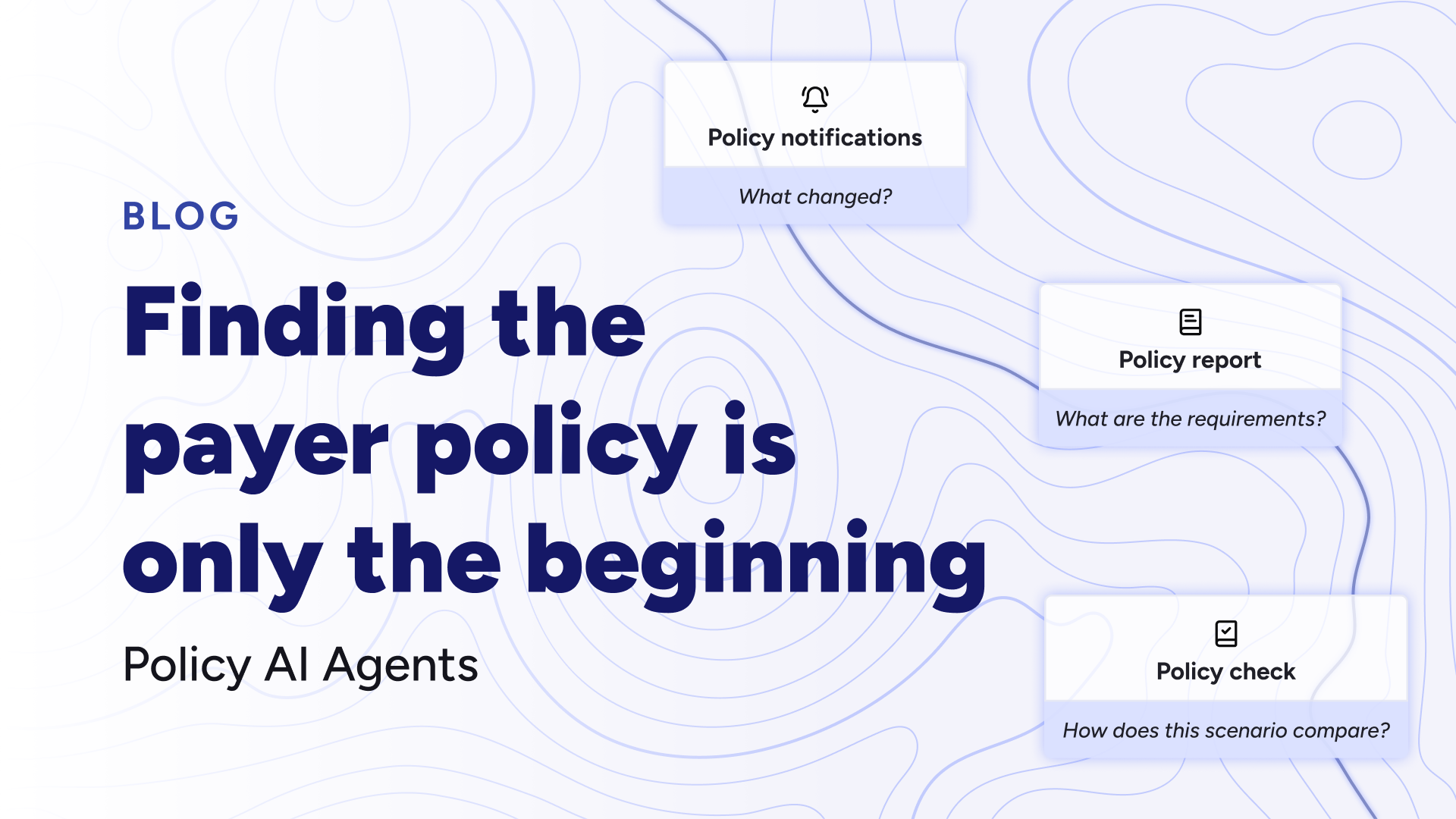
We ingest provider manuals, clinical and administrative policies, medical necessity criteria, and other publicly available policy documents from commercial and government payers. When relevant information is distributed through private payer portals or direct communications, customers can provide those documents for ingestion and analysis within Contract Intelligence.
How will Trek Health’s AI agents evolve over time, and where will development focus next?
Our current AI capabilities support contract analysis, payer policy monitoring, reimbursement research, denial workflows, and underpayment analysis. Our roadmap is deliberately sequenced so each additional layer of information expands what our AI agents can understand, automate, and act on. Future development will include integrating EHR data, expanding the range of information and workflows our AI agents can support across payer performance and revenue cycle management.
What value does Contract Intelligence provide to existing Trek Health Price Intelligence customers?
Contract Intelligence extends the value of Price Intelligence beyond reimbursement benchmarking by making it easier to access market data, analyze payer agreements, manage negotiation timelines, and monitor policy changes. Together, these capabilities give teams a more complete view of payer relationships and help them identify risks and opportunities earlier.
When using AI to search payer data, do users need to know every input required to generate the analysis?
No. Users can describe the analysis they want in natural language. If additional information is required, the system can ask follow-up questions or identify inputs such as billing codes, provider taxonomies, NPIs, and geographic markets based on the request.
Building a More Proactive Approach to Payer Performance
We believe AI can fundamentally change how provider organizations manage payer relationships by shifting teams away from manual research and reactive problem-solving.
Our goal is to enable provider organizations to understand their contracts more quickly, anticipate the impact of payer policy changes, simplify reimbursement analysis, and identify financial risks and opportunities earlier.
If your organization is looking for a better way to manage payer contracts and use AI across the payer contract lifecycle, schedule a demonstration to learn more about Trek Health Contract Intelligence.
White Paper
From Transparency to Prediction: Quantifying the Drivers of Physician Reimbursement Variation
This analysis uses Transparency in Coverage data to model how payers behave, not just what they pay. By linking reimbursement rates to physician characteristics, we uncover the patterns behind payment variation and transform transparency data into predictive intelligence. The result: a predictive view of rate dynamics that helps stakeholders anticipate trends and negotiate with data-driven confidence.

White Paper
Q1 2026 State of Commercial Reimbursement: Trek Health’s Quarterly Market Intelligence
As Trek Health's Quarterly Market Intelligence series matures, more longitudinal trends are emerging. After a brief period of stabilization in late 2025, Q1 2026 brought renewed payer pressure across specialties, geographies, and major national payers. Trek Health's latest Quarterly Market Intelligence report breaks down exactly what shifted — and what it means for your contracts.
Want to see how these trends affect your market? Speak to our team.

White Paper
Q3 2025 State of Commercial Reimbursement: Trek Health’s Quarterly Market Intelligence
Trek Health’s Quarterly Reimbursement Brief highlights emerging variability in commercial payment rates across U.S. payers, specialties, and geographic markets. With some segments experiencing double-digit growth and others notable declines, contracting performance is increasingly shaped by real-time payer behavior rather than historical norms. Through validated reimbursement trend analytics, contract intelligence, and policy monitoring, Trek equips provider organizations to anticipate market shifts, protect revenue, and negotiate with measurable leverage.

White Paper
Q4 2025 State of Commercial Reimbursement: Trek Health’s Quarterly Market Intelligence
Trek Health’s Q4 2025 Quarterly Market Intelligence report analyzes quarter-over-quarter commercial reimbursement movement across national payers, physician specialties, and U.S. states. While overall reimbursement improved following earlier declines, rate changes remained uneven—highlighting payer selectivity, persistent specialty outliers, and shifting geographic leverage. This report moves beyond static benchmarks by tracking real-time reimbursement changes, giving provider organizations actionable insight to identify negotiation risk early, protect rate parity, and respond proactively to evolving payer behavior.

White Paper
Reimbursement and Reality: The Economics of Breast Cancer Treatment
While breast cancer awareness efforts often focus on screening and treatment, one critical factor remains overlooked: how care is reimbursed. Payment structures shape far more than provider margins; they influence access, equity, and patient outcomes.
In this analysis of payer rates, Trek Health uses its Transparency Platform to analyze how reimbursement for breast cancer care varies across geography, commercial payer behavior, and public policy. The findings reveal a system that rewards disease burden rather than prevention which creates inequities that ripple through the entire care process.
Inside you’ll learn:
- How reimbursement rates differ dramatically by state and payer
- Why higher disease burden correlates with higher payment, but prevention does not
- What these trends mean for provider strategy, patient access, and equity
Download the full analysis to see how transparency data can help reshape breast cancer care—turning financial insight into fairer outcomes.

White Paper
Telehealth Parity: Are You Getting Reimbursed When Doing What’s Right for the Patient?
Telehealth reimbursement fell below in-office rates in 98% of observations across major commercial payers for established patient visits. State parity laws showed no association with improved commercial reimbursement equity, a finding explained in part by ERISA preemption of self-funded employer plans.
Read the full analysis for payer-level breakdowns and implications for federal policy.

White Paper
The Cost of Policy Drift: A Framework for Measuring and Managing Payer Policy Lag as an Operational Risk
Commercial payers change coverage criteria, prior authorization requirements, and coding guidelines continuously and without standardized notice, leaving provider organizations to detect, interpret, and operationalize each update on their own. The lag between when a payer changes a rule and when that change is fully reflected in an organization's workflows is a distinct, measurable operational risk we term Policy Drift. Left unnamed and unmeasured, Policy Drift generates denial volume, prior authorization friction, fee schedule underpayment, and audit exposure that most organizations misattribute to clinical or documentation failure.
This paper introduces a four-stage latency framework for decomposing Policy Drift into its constituent components, a KPI set for tracking it, and the infrastructure requirements for closing it systematically.

White Paper
The Economics of Payer Contract Management Automation: Quantifying Cost Savings & Revenue Lift
Trek Health's Contract Intelligence (CI) automates contract interpretation and policy maintenance, transforming unstructured payer data into actionable rules. Using industry benchmarks and multi-scenario modeling across clinic, multispecialty, and hospital environments, CI generates annual savings ranging from $80K to over $9.3M, driven by avoided denials, reduced administrative labor, and streamlined policy-update workflows. Our results show that CI functions as core financial infrastructure rather than a point solution, delivering structural value across the reimbursement lifecycle.

White Paper
The Payer Paradox: When Higher Rates Don’t Mean Higher Reimbursement
This analysis uncovers a critical paradox in commercial healthcare financing: the payers offering the highest contracted rates often deliver the lowest realized reimbursement once denials and administrative friction are accounted for. By introducing the Payer Generosity Index (PGI) and adjusted PGI (aPGI), Trek Health reveals how payer performance varies not only across insurers, but across specialties and service lines. These findings equip healthcare organizations with a clearer, data-driven framework for contracting, revenue optimization, and strategic planning in an increasingly complex reimbursement landscape.

White Paper
The Private Practice Playbook: Rate Negotiation Index Rankings for Specialty-Specific M&A Strategy
Physician economics are shifting as private equity and independent platforms redefine the workforce landscape. Trek Health’s Rate Negotiation Index Report quantifies the return on physician labor across states and specialties in a new lens: combining commercial reimbursement, physician salary, malpractice risk, and provider density into a single metric. This data driven foundation for smarter M&A strategy identifies the most economically sustainable opportunities across the U.S. for physician recruitment and network expansion.

Published on
July 13, 2026
Written by
Ryan KellyProvider organizations have access to more payer performance data than ever before. But more data does not necessarily lead to improved financial outcomes, particularly when critical information is spread across disconnected tools and systems. Bringing that information together and making it easier to analyze and act on creates an opportunity to manage payer relationships more effectively.
During our recent Contract Intelligence webinar, CEO and Co-Founder Dilpreet Sahota demonstrated how we are using AI to help provider organizations address four persistent gaps in contract, market, payer policy, and operational visibility. The discussion explored how AI can analyze complex information, automate time-consuming workflows, and surface actionable insights that help teams manage payer relationships more proactively.
Contract Intelligence: A Modern Approach to Managing Payer Performance
We built Contract Intelligence to bring together the information provider organizations need to manage payer relationships, evaluate performance, and make informed decisions across the payer contract lifecycle. The platform can ingest payer contracts, amendments, fee schedules, claims and remittance data, payer policies, direct payer communications, and other internal and external data sources.
Once this information is ingested, teams can use natural language to ask questions and receive answers linked directly to the underlying source documents. During the webinar, we demonstrated how users can quickly locate effective dates, termination provisions, reimbursement terms, billing requirements, and other critical information without manually reviewing hundreds of pages.
For more complex tasks, AI agents can analyze information from multiple sources and automate workflows such as structured contract extraction, negotiation term prioritization, contract-to-policy comparisons, denial analysis, and appeal letter generation.
We also highlighted our work with Family Allergy & Asthma, where centralizing payer agreements and using AI to streamline contract analysis helped reduce contract review time by more than 80%.
Extending AI Across the Payer Contract Lifecycle
Contract search and analysis are only the starting point. Contract Intelligence can apply AI to more complex workflows to help teams identify contract-policy conflicts, investigate denials and underpayments, prioritize negotiation opportunities, and evaluate market reimbursement rates.
One example shared in the webinar highlighted a contract that allowed a 180-day timely filing period while the payer’s public policy specified a 60-day standard. Surfacing this type of discrepancy helps teams identify potential denials, underpayments, and operational risks before they create larger financial consequences.
We also previewed the planned integration of our Transparency in Coverage data into Contract Intelligence. Users will be able to describe the reimbursement information they need in natural language, allowing the solution to identify relevant providers, billing codes, specialties, and geographic parameters before querying the data and returning results.
Audience Q&A
What types of payer policies does Trek Health search for? Is the focus limited to clinical policies, or are administrative policies included as well?
We ingest provider manuals, clinical and administrative policies, medical necessity criteria, and other publicly available policy documents from commercial and government payers. When relevant information is distributed through private payer portals or direct communications, customers can provide those documents for ingestion and analysis within Contract Intelligence.
How will Trek Health’s AI agents evolve over time, and where will development focus next?
Our current AI capabilities support contract analysis, payer policy monitoring, reimbursement research, denial workflows, and underpayment analysis. Our roadmap is deliberately sequenced so each additional layer of information expands what our AI agents can understand, automate, and act on. Future development will include integrating EHR data, expanding the range of information and workflows our AI agents can support across payer performance and revenue cycle management.
What value does Contract Intelligence provide to existing Trek Health Price Intelligence customers?
Contract Intelligence extends the value of Price Intelligence beyond reimbursement benchmarking by making it easier to access market data, analyze payer agreements, manage negotiation timelines, and monitor policy changes. Together, these capabilities give teams a more complete view of payer relationships and help them identify risks and opportunities earlier.
When using AI to search payer data, do users need to know every input required to generate the analysis?
No. Users can describe the analysis they want in natural language. If additional information is required, the system can ask follow-up questions or identify inputs such as billing codes, provider taxonomies, NPIs, and geographic markets based on the request.
Building a More Proactive Approach to Payer Performance
We believe AI can fundamentally change how provider organizations manage payer relationships by shifting teams away from manual research and reactive problem-solving.
Our goal is to enable provider organizations to understand their contracts more quickly, anticipate the impact of payer policy changes, simplify reimbursement analysis, and identify financial risks and opportunities earlier.
If your organization is looking for a better way to manage payer contracts and use AI across the payer contract lifecycle, schedule a demonstration to learn more about Trek Health Contract Intelligence.