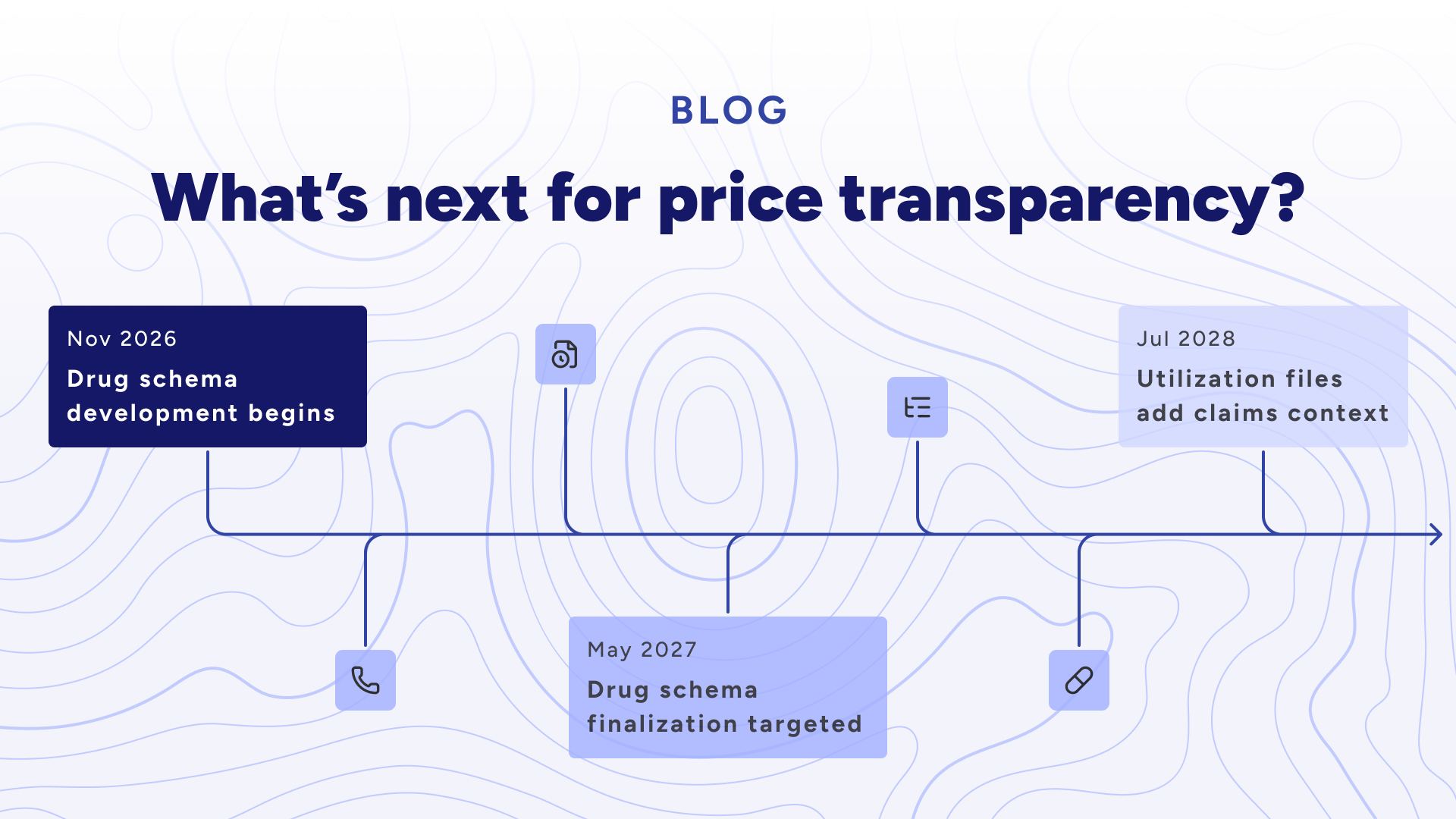
Timeline graphic highlights selected milestones. Prescription-drug dates reflect the announced roadmap: development is planned for November 2026 and schema finalization around May 2027 (HHS announcement).
Price transparency is getting more usable. Here’s what changes.
By Dilpreet Sahota, Founder and CEO, Trek Health · October 7, 2026
A managed care leader needs to know whether a benchmark will hold up in a payer negotiation. A CFO needs to know whether a rate difference represents a real financial opportunity. A patient needs to know what they will owe before committing to care.
Those are different questions. Publishing more prices does not, by itself, answer any of them.
On October 5, HHS, CMS, Labor, and Treasury finalized updates to the Transparency in Coverage rules that address the usability of public payer data, strengthen accountability for its accuracy, and expand access to personalized cost-sharing information. (HHS announcement) For healthcare stakeholders, the opportunity is to move from finding a price to understanding what that price means for a decision.
At Trek, that is the distinction that matters. Better data is the foundation; a defensible answer is the goal.
What actually changed
The public-file requirements generally apply to non-grandfathered group health plans and issuers of non-grandfathered group or individual coverage; the phone-access provisions also address grandfathered plans and coverage through alignment with the No Surprises Act (CMS fact sheet).
The new requirements address several obstacles between a published rate and a useful comparison:
- Less duplication: In-network reporting moves from one file per plan or policy to one file per provider network, with network names, identifiers, and plan product types providing more context. (CMS fact sheet)
- Fewer irrelevant rates: Plans and issuers must remove provider-service combinations unlikely to be reimbursed given the provider’s specialty, using their internal taxonomy or claims-adjudication rules. (CMS fact sheet)
- More context: New taxonomy files will explain the filtering rules, while separate utilization files will identify provider-service combinations with qualifying claims activity. (Final rule, 45 CFR 147.212(b)(2))
- Broader out-of-network visibility: Reporting will aggregate by insurance market type, lower the disclosure threshold from 20 to 11 claims, and expand the reporting period. (CMS fact sheet)
- Greater accountability: Attestations and named senior officials will put explicit responsibility behind published information, while locator files and website links will make disclosures easier to find. (CMS fact sheet)
- A different update cadence: In-network and out-of-network medical-rate files will move from monthly to quarterly publication; prescription-drug files retain a monthly cadence. (Final rule, 45 CFR 147.212(b)(4))
The rule estimates that removing unlikely provider-rate combinations could reduce in-network file sizes by roughly 70%. (Final rule, regulatory impact analysis) That is a data-processing improvement, not a claim that healthcare prices will fall by 70% or that every remaining rate is automatically comparable.
What it means for healthcare stakeholders
Providers and managed care teams
Stronger comparisons, not automatic leverage
Network-level reporting and clearer product identifiers should make it easier to investigate whether two rates belong in the same comparison. (CMS fact sheet) Our recommendation is to use that added context to make the benchmark narrower and more defensible, rather than simply making the comparison set larger.
Consider a surgery center comparing reimbursement for one procedure. The useful question is not, “What is the highest rate in the market?” It is, “Which providers, networks, settings, and payment arrangements are genuinely comparable to ours?”
Better transparency can support a request for a rate increase. It can also challenge an assumption that your organization is underpaid. The value is a negotiation grounded in evidence, not a guarantee that the evidence favors one side.
CFOs and revenue cycle leaders
Separate opportunity from recoverable revenue
For finance teams, we recommend treating a market-rate gap as the start of an investigation. Before putting dollars into a forecast, connect the benchmark to the organization’s actual service volume, payer mix, contract terms, and payment evidence.
That means keeping three questions separate:
- Market position: How do our negotiated rates compare with relevant peers?
- Contract performance: What should this payer reimburse under our agreement?
- Payment performance: What did the payer actually pay, and why?
A benchmark gap is not an underpayment, and an underpayment estimate is not a recovered dollar. The practical opportunity is to connect these questions without treating their answers as interchangeable.
Employers and benefit advisers
Evaluate networks, not just discounts
The new network and product identifiers create a better starting point for comparing the prices underlying coverage options. (CMS fact sheet) We see an opportunity for employers to ask more specific questions about how a proposed network would perform for their own members.
For example: how would two networks compare for the services employees actually use, in the places where they receive care? Evaluate the answer alongside access, quality, benefit design, and administrative costs. A lower unit price is useful evidence, but it should not be presented as a complete measure of plan value or a guaranteed reduction in total spending.
Health plans, TPAs, and data teams
Accuracy becomes an operating responsibility
The rules pair reduced duplication and a quarterly medical-file cadence with stronger accuracy and accountability requirements. (CMS fact sheet) Our recommendation is to treat implementation as a data-quality program, not just a publishing project.
That program should reconcile published rates to underlying agreements, document exclusions, preserve network mappings, and establish an owner for correcting errors. Teams consuming the data should also preserve file dates and versions: a cleaner quarterly file should not be presented as a real-time view.
Patients and patient-access teams
Accessibility and completeness both matter
Plans and issuers must make personalized cost-sharing information available by phone upon request for plan or policy years beginning on or after January 1, 2027, alongside existing online and paper access. (CMS fact sheet) This is a payer obligation, not a new universal requirement for every provider office to quote prices by telephone.
Separately, the FTC sent warning letters on October 5 to 24 large healthcare-services companies, emphasizing timely, accurate, and complete pricing disclosures for scheduled care and warning that CMS compliance is not a safe harbor from FTC Act liability. (FTC announcement) The letters are warnings, not findings that the recipients violated the law. (FTC letter template)
For patient-access teams, our recommendation is to review the whole communication: what care is included, which professionals may bill separately, what information is patient-specific, and what uncertainty remains. A public negotiated rate should not be presented as the patient’s final out-of-pocket obligation.
Pharmacy stakeholders and technology builders
Prepare for the next dataset
HHS announced that prescription-drug file schema development is planned to begin in November 2026, with finalization around May 2027 and publication using that schema expected to begin in December 2027. (HHS announcement) The underlying disclosure framework includes negotiated rates and historical net prices for covered prescription drugs. (CMS fact sheet)
For employers, pharmacy teams, PBMs, manufacturers, and analytics developers, we see a future opportunity to test pricing assumptions against a more structured public dataset. But the schema is still ahead: do not promise that the files will reveal every commercial arrangement, establish a patient-specific pharmacy quote, or independently measure provider drug margins.
Start with the questions the data should help answer. Validate the actual fields and coverage before building conclusions around them.
The rollout is phased, not immediate
The rule’s applicability dates and its first file-posting dates are not the same. The regulatory text sets March 6, 2027 for the main medical-file amendments and September 6, 2027 for contextual-file provisions, with separate posting schedules, including a July 2028 start for utilization files. (Final rule, 45 CFR 147.212(b)(4) and (c)(1))
The final rule discusses payer Schema 3.0 as a technical implementation process that will develop alongside these requirements; April 1 marks the first revised medical-file posting, not a separately announced schema-release date. (Final rule, section III.C.13 and 45 CFR 147.212(b)(4)) Treat it as a phased transition, not a claim that a completed new dataset became available on announcement day.
Better transparency should lead to better decisions
The most useful next step is not to wait for every milestone. Pick one consequential decision and define the evidence needed to make it: a payer renewal, a service-line investment, a benefit-network comparison, or a patient estimate.
For provider organizations, Trek connects payer contracts, policies, and transparency data to support benchmarking, modeling, and reimbursement decisions. (Trek Health platform overview) Our view is that more usable public data makes that work more valuable, not less necessary.
Transparency gives the market more information. The next step is to turn that information into an answer someone can verify and act on.
Bring Trek one payer, one service line, and one decision you need to make. Let’s identify the evidence required to move it forward.