By Dilpreet Sahota, Founder and CEO, Trek Health · October 2, 2026
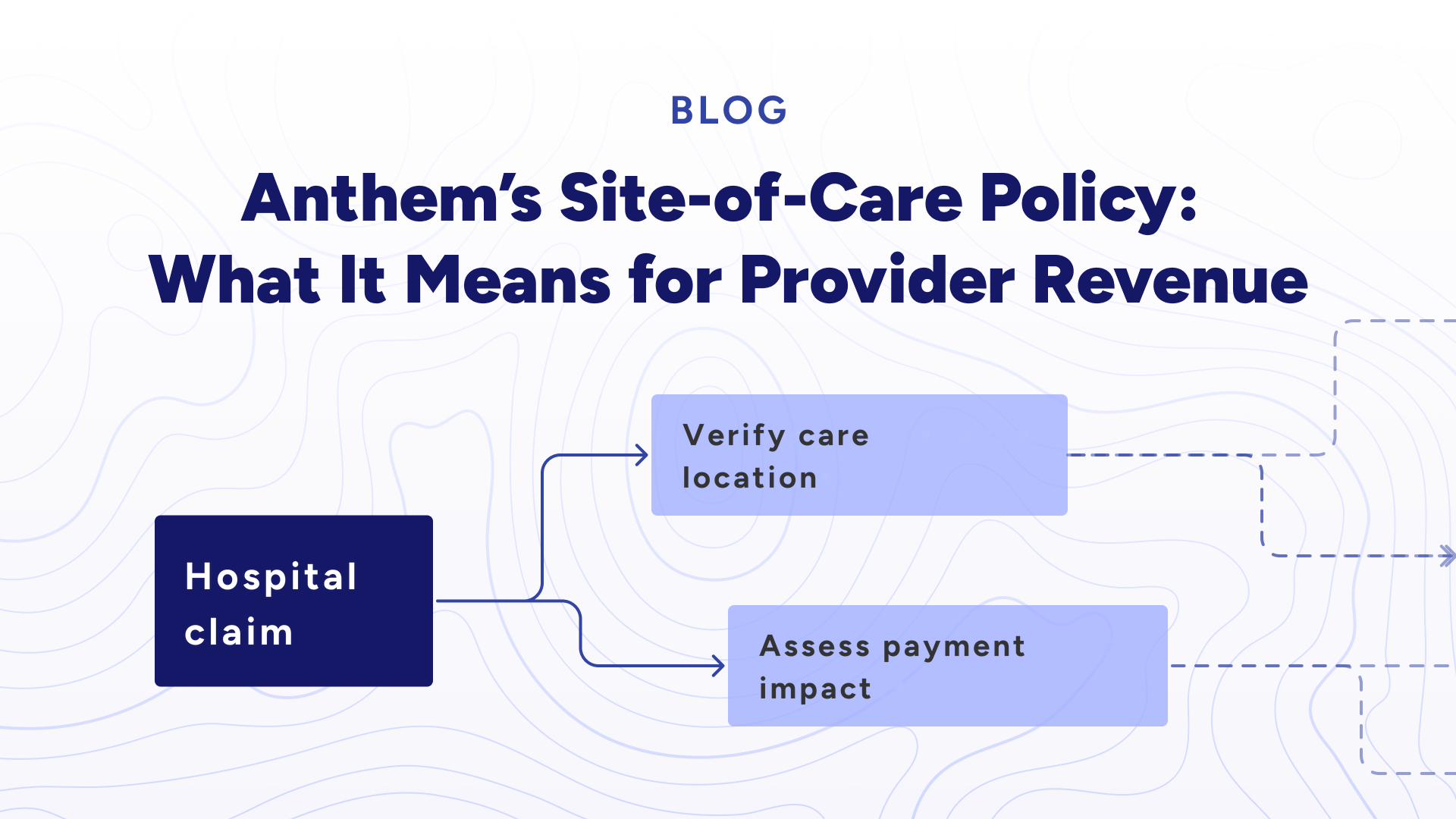
On September 29, 2026, Elevance Health announced new billing policies that connect where care is delivered to how certain hospital services are paid. The policies will require hospitals to identify the physical location of care, check billing information against hospital addresses, apply the appropriate off-campus rate to certain off-campus services, and prevent higher hospital billing for certain laboratory tests performed elsewhere (Elevance announcement).
For a provider organization, that raises a practical question: could the same service, delivered at the same location, produce a different payment?
Elevance says the policies will roll out during 2026 and 2027 across its commercial, Medicare Advantage, and Medicaid businesses. The announcement does not provide a universal effective date, a complete list of affected services, or a payment formula that a provider can apply across its book of business (Elevance announcement).
That is why the useful output is not simply an alert saying “site-of-care policy changed.” It is a decision brief that tells finance, RCM, and managed care what is known, which records need review, and what evidence is still needed before estimating an impact.
Here is a worked example of that investigation. The encounter counts, classifications, payment assumptions, and costs are hypothetical teaching inputs, not Elevance rates, verified affected services, customer results, or an observed agent run.
Start with what was announced, not an assumed rate cut
Elevance describes these changes as billing and reimbursement policies, including payment adjustments for certain off-campus hospital services. Its accompanying explanation says the issue is not limited to one specialty or type of care (Elevance policy explanation).
The four announced actions should lead to four separate checks:
The announced actions above come from Elevance’s September 29 release; the investigation questions are a proposed provider response, not additional requirements stated in that release (official announcement).
An off-campus address is a reason to investigate. It is not, by itself, proof that every service at that address will be repriced.
Before estimating a dollar impact, the team should retrieve the relevant provider notice, detailed reimbursement policy, and executed agreement. It should establish the market and product, affected services, implementation date, location definitions, exceptions, required claim fields, and payment method. Commercial, Medicare Advantage, and Medicaid implementation should be assessed separately rather than assuming the announcement creates identical rules for each.
The news has already drawn provider attention. Healthcare Dive reported AHA concerns about reimbursement reductions and access, while ASGE advised practices to watch for implementation guidance affecting location reporting, claims, and facility reimbursement (Healthcare Dive, ASGE).
For an individual health system, neither the payer’s stated rationale nor the industry response substitutes for that organization’s own applicability and contract review.
Work the question through one outpatient service line
Consider a hypothetical health system reviewing 1,000 monthly encounters in one outpatient service line under one commercial product. Its leadership asks:
“Which encounters could be exposed to an off-campus payment adjustment, what do we need to verify, and what would different payment assumptions mean financially?”
For this illustration, the team joins encounter records to actual service locations, claim details, payer products, and contract references. It keeps three questions distinct: where the service occurred, whether a specific policy applies, and how payment would be calculated.
Suppose that first pass creates the following mutually exclusive review groups:
These are invented teaching categories, not an estimate of Elevance’s affected population. None of the 1,000 encounters becomes a confirmed payment reduction merely because it appears in the review.
The 400 candidates are a planning cohort, not 400 established policy findings. The other 300 off-campus or unresolved encounters remain open work, not zero-risk cases.
That distinction matters to each executive. Finance gets a bounded scenario, RCM gets a data-quality and claims-review queue, and managed care gets a specific set of applicability and agreement questions to resolve.
Model a payment change without inventing a care transfer
Now isolate those 400 candidates. For the financial illustration only, assume that subsequent review confirms all 400 are subject to a payment adjustment and that the alternative payment assumption can be translated into expected net collections.
Keep the service, location, encounter count, and payment components constant. No patient changes sites in this model; the scenario isolates a change in payment for care already delivered off campus.
Under these assumptions, expected collections fall by $60,000 for the modeled month. Contribution falls by the same amount because volume and variable costs have not changed.
The $350 figure is not an announced Elevance rate, and the example is not a forecast of a 30% cut. It is a transparent scenario showing how a payment assumption flows through the economics of a fixed population.
A sensitivity view makes the uncertainty easier to discuss:
These are alternative assumptions, not probabilities or a published payer fee schedule. A real model would replace them with the applicable payment methodology and validated collection assumptions, aligning coding, modifiers, units, professional and facility components, and patient responsibility.
The illustration excludes implementation costs, changes in fixed costs, volume shifts, and collection-timing effects. A real forecast would also need the actual effective date before extending any monthly scenario over a longer period.
Give each team a decision it can own
The investigation should produce one shared evidence file, with clear ownership of the next steps. A useful handoff would include:
- RCM: Reconcile actual service locations with claim and enrollment records, identify the claim fields required by the applicable guidance, test the billing workflow, and monitor adjudication after implementation.
- Managed care: Review the relevant product, policy notice, executed contract, and amendments; assess payment terms and notice provisions; seek written clarification of unresolved applicability or rate questions.
- Finance: Separate confirmed exposure from provisional scenarios, replace assumed collections with validated inputs, and show the sensitivity to affected volume and payment methodology.
- Service-line leadership: Assess the operating implications of any validated payment change, including capacity and access considerations, without treating a financial model as an instruction to relocate care.
The decision may be to correct a location mapping, change a claims workflow, challenge an interpretation, negotiate a term, or monitor results. Those are different responses, and they require different evidence.
Where Trek’s agents fit
Trek’s Policy Agents include policy-change notifications, structured policy reports, and checks of claims or reimbursement scenarios against current payer policy. Those capabilities are relevant to finding the applicable requirements and organizing the evidence needed for review (Trek’s agent catalog).
Contract Agents include structured contract reporting, rate extraction, and scenario modeling; Revenue Agents include underpayment analysis and denial review connected to contracts and policies. Those are the next layers of evidence when a policy question becomes a payment question (Trek’s agent catalog).
The workflow proposed here is a practical way to connect those questions, not a claim that a public announcement supplies every answer or that this entire investigation has already been executed by an agent. Location data, policy scope, contractual terms, and actual claims results each need their own validation.
That is the standard we want payer intelligence to meet. The useful result is a traceable path from the announcement to the population under review, the assumptions behind the financial model, and the next decision.
Start your own payer research for free
You do not need to buy Trek’s enterprise platform to start researching payer questions. OpenPayer is our free research tool for asking plain-language questions about coverage, prior authorization, coding, and reimbursement, with source-linked answers on demand. No purchase or sales demo is required to get started.
Research payer questions for free
Free research. No purchase or sales demo required. Opens in a new tab.
Bring a specific payer, service or billing code, state, and plan type. Use the answer as a starting point, open the supporting sources, and verify publication dates, effective dates, and product applicability before acting; AI-assisted research is not a payer authorization or a guarantee of payment.
For organization-specific analysis using your contracts and claims, bring one payer, one outpatient service line, and one billing question to a working session with Trek. We’ll work through what the published materials establish, what evidence your organization needs, and which decisions come next. Explore Trek’s enterprise agents.
Research note: Prepared October 2, 2026, using Elevance Health’s September 29, 2026 announcement and accompanying explanation. The announcement describes a series of policies rolling out during 2026–2027; it does not establish a single implementation date, a universal payment reduction, or complete service-, market-, and product-specific rules (Elevance announcement, policy explanation). All populations, financial inputs, and review classifications in this article are hypothetical. This is an illustrative decision framework, not a customer case study, observed agent execution, contractual determination, or prediction of payer payment.
Sources and research resources
- Elevance Health announcement, September 29, 2026: Primary source for the announced billing policies and 2026–2027 rollout.
- Elevance Health policy explanation: Payer explanation of the changes and their intended scope.
- Healthcare Dive coverage: Reporting on the announcement and hospital-sector response.
- ASGE provider update: Provider-facing discussion of potential billing and reimbursement implications.
- OpenPayer: Free, on-demand payer research with source-linked answers; a tool for readers’ own research, not the primary source of Elevance’s announcement.
- OpenPayer data sources and methodology: Source organizations, citation approach, and refresh methodology.
- Trek’s agent catalog: Descriptions of the enterprise capabilities discussed in this article.