Why Most Payer Comparisons Fall Short: The Importance of Plan-Level Transparency

Benchmarking reimbursement is supposed to answer a simple question: how do your rates compare to the market?

In practice, most benchmarks fail to answer that question accurately. The reason is straightforward. They average reimbursement across entire payers, even though a single payer may operate dozens of distinct plans, each with its own negotiated pricing.

Why Payer-Level Averages Distort Reimbursement Benchmarks

Within the same carrier, reimbursement can vary dramatically depending on employer size, network structure, and contract history. Large national employer plans often reimburse meaningfully higher than small-group or exchange products. Medicare Advantage plans may behave differently from commercial plans under the same payer umbrella. When these fundamentally different plans are blended into a single average, the resulting benchmark reflects a mix of contracts that no individual provider actually has.

This creates noise that makes benchmarks difficult to interpret. A provider may appear to be paid below market simply because their patient mix skews toward lower-paying plans. Conversely, a strong benchmark may reflect favorable plan mix rather than stronger negotiated rates. Without plan-level visibility, it becomes difficult to distinguish between contract performance and contract composition.

The Importance Plan-Level Visibility Matters

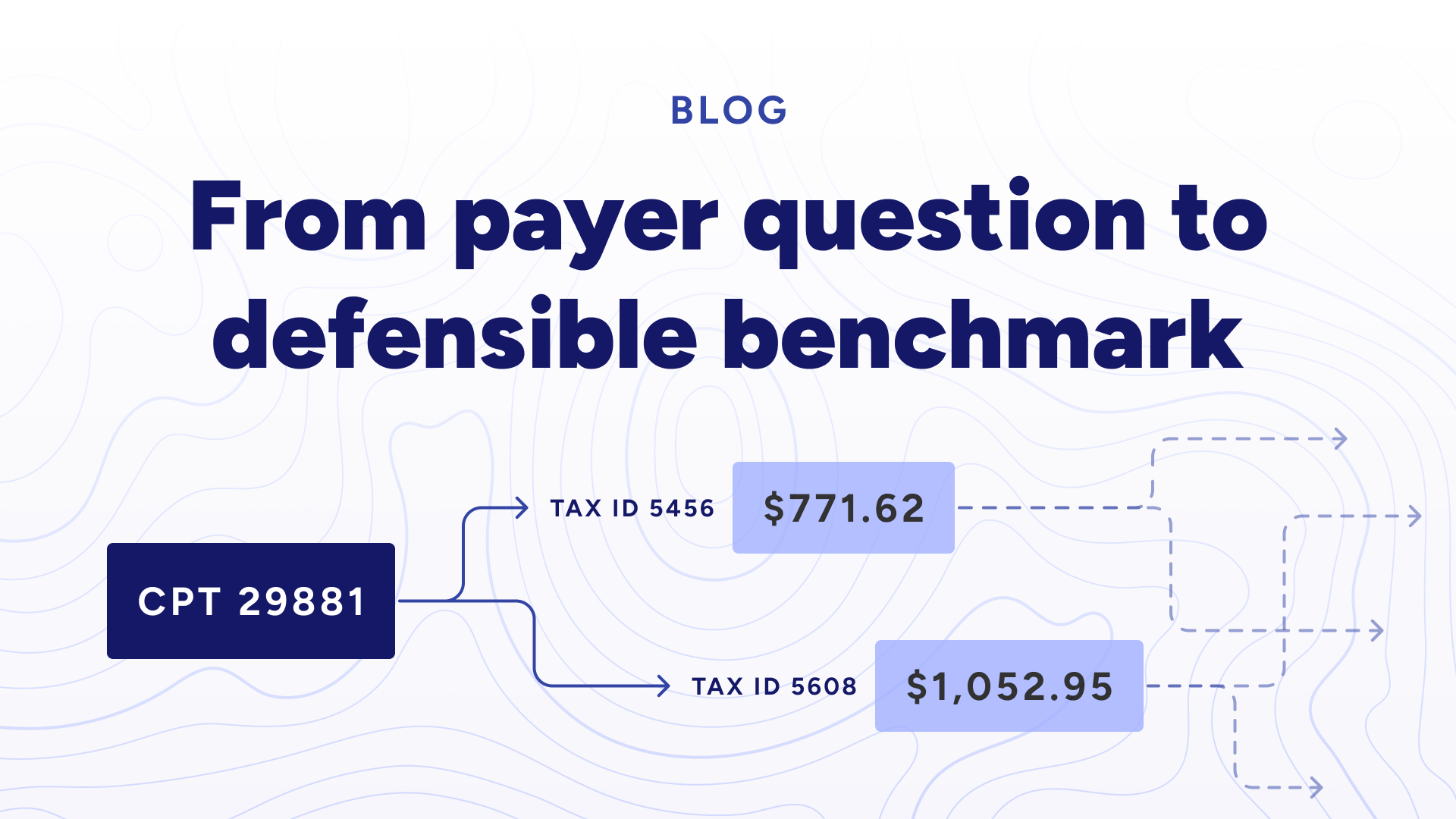
Trek Health solves this problem by exposing reimbursement at the individual plan level. Instead of collapsing rates into a single payer-wide average, Trek preserves the negotiated amounts associated with each specific plan. This enables direct comparison between equivalent contracts, ensuring that benchmarks reflect true differences in negotiated reimbursement, not differences in plan mix.

This level of granularity allows providers to evaluate their performance against the plans that actually exist in their market. Health systems can identify which plans reimburse above or below market norms. Investors and operators can assess whether reimbursement differences between organizations reflect negotiation strength or simply variation in employer composition. Contracting teams can prioritize negotiation efforts based on plans with the greatest opportunity for improvement.

Plan-level transparency also reveals variation that would otherwise remain hidden. Even within a single payer and geography, negotiated rates may differ substantially between plans. These differences are often invisible in payer-level averages but become clear when analyzed individually.

Elevate Benchmarking with Plan-Level Intelligence

Benchmarks are only useful when they reflect comparable contracts. By enabling plan-level analysis, Trek Health removes the distortion created by blended averages and provides a clearer view of how reimbursement behaves across the market. This allows providers, operators, and investors to evaluate reimbursement with greater precision and make decisions grounded in directly comparable data.

Trek Health’s Price Transparency Platform is built exclusively for provider organizations and transforms complex Transparency in Coverage data into actionable, plan-level intelligence that supports stronger reimbursement strategies and improved financial performance. If your organization is relying on payer-level averages to guide negotiation strategy, it may be time to adopt plan-level transparency. Connect with Trek Health to see how precise benchmarking can strengthen your next payer negotiation cycle.
Download White Paper

Why Most Payer Comparisons Fall Short: The Importance of Plan-Level Transparency

White Paper

From Transparency to Prediction: Quantifying the Drivers of Physician Reimbursement Variation

This analysis uses Transparency in Coverage data to model how payers behave, not just what they pay. By linking reimbursement rates to physician characteristics, we uncover the patterns behind payment variation and transform transparency data into predictive intelligence. The result: a predictive view of rate dynamics that helps stakeholders anticipate trends and negotiate with data-driven confidence.

Download the White Paper

White Paper

Q3 2025 State of Commercial Reimbursement: Trek Health’s Quarterly Market Intelligence

Trek Health’s Quarterly Reimbursement Brief highlights emerging variability in commercial payment rates across U.S. payers, specialties, and geographic markets. With some segments experiencing double-digit growth and others notable declines, contracting performance is increasingly shaped by real-time payer behavior rather than historical norms. Through validated reimbursement trend analytics, contract intelligence, and policy monitoring, Trek equips provider organizations to anticipate market shifts, protect revenue, and negotiate with measurable leverage.

Download the White Paper

White Paper

Q4 2025 State of Commercial Reimbursement: Trek Health’s Quarterly Market Intelligence

Trek Health’s Q4 2025 Quarterly Market Intelligence report analyzes quarter-over-quarter commercial reimbursement movement across national payers, physician specialties, and U.S. states. While overall reimbursement improved following earlier declines, rate changes remained uneven—highlighting payer selectivity, persistent specialty outliers, and shifting geographic leverage. This report moves beyond static benchmarks by tracking real-time reimbursement changes, giving provider organizations actionable insight to identify negotiation risk early, protect rate parity, and respond proactively to evolving payer behavior.

Download the White Paper

White Paper

Reimbursement and Reality: The Economics of Breast Cancer Treatment

While breast cancer awareness efforts often focus on screening and treatment, one critical factor remains overlooked: how care is reimbursed. Payment structures shape far more than provider margins; they influence access, equity, and patient outcomes.

In this analysis of payer rates, Trek Health uses its Transparency Platform to analyze how reimbursement for breast cancer care varies across geography, commercial payer behavior, and public policy. The findings reveal a system that rewards disease burden rather than prevention which creates inequities that ripple through the entire care process.

Inside you’ll learn:

  • How reimbursement rates differ dramatically by state and payer
  • Why higher disease burden correlates with higher payment, but prevention does not
  • What these trends mean for provider strategy, patient access, and equity

Download the full analysis to see how transparency data can help reshape breast cancer care—turning financial insight into fairer outcomes.

Download the White Paper

White Paper

The Payer Paradox: When Higher Rates Don’t Mean Higher Reimbursement

This analysis uncovers a critical paradox in commercial healthcare financing: the payers offering the highest contracted rates often deliver the lowest realized reimbursement once denials and administrative friction are accounted for. By introducing the Payer Generosity Index (PGI) and adjusted PGI (aPGI), Trek Health reveals how payer performance varies not only across insurers, but across specialties and service lines. These findings equip healthcare organizations with a clearer, data-driven framework for contracting, revenue optimization, and strategic planning in an increasingly complex reimbursement landscape.

Download the White Paper

White Paper

The Private Practice Playbook: Rate Negotiation Index Rankings for Specialty-Specific M&A Strategy

Physician economics are shifting as private equity and independent platforms redefine the workforce landscape. Trek Health’s Rate Negotiation Index Report quantifies the return on physician labor across states and specialties in a new lens: combining commercial reimbursement, physician salary, malpractice risk, and provider density into a single metric. This data driven foundation for smarter M&A strategy identifies the most economically sustainable opportunities across the U.S. for physician recruitment and network expansion.

Download the White Paper

Published on

February 19, 2026

Written by

Jordan Kassab

Benchmarking reimbursement is supposed to answer a simple question: how do your rates compare to the market?

In practice, most benchmarks fail to answer that question accurately. The reason is straightforward. They average reimbursement across entire payers, even though a single payer may operate dozens of distinct plans, each with its own negotiated pricing.

Why Payer-Level Averages Distort Reimbursement Benchmarks

Within the same carrier, reimbursement can vary dramatically depending on employer size, network structure, and contract history. Large national employer plans often reimburse meaningfully higher than small-group or exchange products. Medicare Advantage plans may behave differently from commercial plans under the same payer umbrella. When these fundamentally different plans are blended into a single average, the resulting benchmark reflects a mix of contracts that no individual provider actually has.

This creates noise that makes benchmarks difficult to interpret. A provider may appear to be paid below market simply because their patient mix skews toward lower-paying plans. Conversely, a strong benchmark may reflect favorable plan mix rather than stronger negotiated rates. Without plan-level visibility, it becomes difficult to distinguish between contract performance and contract composition.

The Importance Plan-Level Visibility Matters

Trek Health solves this problem by exposing reimbursement at the individual plan level. Instead of collapsing rates into a single payer-wide average, Trek preserves the negotiated amounts associated with each specific plan. This enables direct comparison between equivalent contracts, ensuring that benchmarks reflect true differences in negotiated reimbursement, not differences in plan mix.

This level of granularity allows providers to evaluate their performance against the plans that actually exist in their market. Health systems can identify which plans reimburse above or below market norms. Investors and operators can assess whether reimbursement differences between organizations reflect negotiation strength or simply variation in employer composition. Contracting teams can prioritize negotiation efforts based on plans with the greatest opportunity for improvement.

Plan-level transparency also reveals variation that would otherwise remain hidden. Even within a single payer and geography, negotiated rates may differ substantially between plans. These differences are often invisible in payer-level averages but become clear when analyzed individually.

Elevate Benchmarking with Plan-Level Intelligence

Benchmarks are only useful when they reflect comparable contracts. By enabling plan-level analysis, Trek Health removes the distortion created by blended averages and provides a clearer view of how reimbursement behaves across the market. This allows providers, operators, and investors to evaluate reimbursement with greater precision and make decisions grounded in directly comparable data.

Trek Health’s Price Transparency Platform is built exclusively for provider organizations and transforms complex Transparency in Coverage data into actionable, plan-level intelligence that supports stronger reimbursement strategies and improved financial performance. If your organization is relying on payer-level averages to guide negotiation strategy, it may be time to adopt plan-level transparency. Connect with Trek Health to see how precise benchmarking can strengthen your next payer negotiation cycle.