A payer offers a 5% increase at renewal. Before you recommend accepting it or take a counterproposal to finance, you need to know what that increase means across the services your organization actually delivers.
Which reimbursement terms change? Which stay untouched? And if the offer falls short of your target, where should you focus the counterproposal?
The useful output is not another contract summary. It is a clear view of what each agreement requires and a position you can explain internally, support with evidence, and take back to the payer.
Make the contract usable beyond the rate table
The complexity does not stop at reimbursement rates. Billing rules, administrative obligations, and procedural requirements also need to be understood in the context of the agreement, its amendments, and its exhibits.
What must accompany a claim? Which notice or filing deadlines apply? What steps does the agreement require for authorization, a dispute, or an appeal?
Now extend those questions across your payer portfolio. The challenge is not just finding a provision in one PDF; it is organizing different terms, exceptions, and effective periods into a reference your team can actually use.
Trek’s Contract Agents help turn PDF agreements into a structured, human-readable Excel document that organizes those terms across your payer contracts. Rather than leave each agreement as an isolated document, the output gives your team a consistent way to review billing, administrative, and procedural requirements side by side.
Think of a workbook organized by payer, product, agreement, and term category, with plain-language requirements, applicable conditions or deadlines, effective dates, and supporting source references. The structure should make differences easier to see without stripping away the qualifications that make a provision apply.
That gives contracting, billing, and operations a shared reference. A renewal model is one use of that organized information; understanding what the team needs to do under each agreement is another.
Price the offer, not the headline
Consider a simplified agreement with $19 million in annual modeled allowed amounts. Of that, $10 million is paid under a base fee schedule and $9 million under separately negotiated carve-outs.
The payer proposes a 5% increase to the base schedule, with no change to the carve-outs. Hold utilization constant and apply the proposed rates for a full year to isolate the rate-change effect.
The base schedule increases by 5%. Across the modeled service mix, the increase is approximately 2.6%.
There is nothing contradictory about those two numbers. They answer different questions, and the renewal recommendation should make both visible.
This is an illustrative example, not a customer result or an observed product run. The figures represent modeled allowed amounts, not billed charges, actual payments, or a forecast of cash collections.
Turn the gap into a counterproposal
Now suppose your team’s target is a 4% increase across that same modeled business. That would require $760,000 in additional annual allowed amounts, leaving a $260,000 gap between the offer and the target.
The next question is no longer simply, “Can we get more than 5%?” It is, “Which combination of reimbursement changes would close the gap?”
Under these simplified assumptions, two possible paths are:
- A larger base-schedule increase: A 7.6% increase on the $10 million base would produce $760,000, with carve-outs unchanged.
- A combination of changes: Keep the proposed 5% base increase and identify another $260,000 in modeled value through changes to selected carve-outs.
Those paths reach the same aggregate target, but they distribute the increase differently. Before choosing a position, examine which services benefit, which remain unchanged, and how the result changes under a different service mix.
A financial target is not, by itself, evidence that the payer should accept a particular rate. It gives the team a defined scenario to evaluate alongside its market evidence, service-line priorities, and negotiating strategy.
That is a stronger basis for the next conversation than asking for another percentage point without showing what it would accomplish. It also gives finance a specific decision to review rather than a headline to interpret.
Make sure the agreement supports the model
Before any scenario becomes a negotiating position, establish which documents and reimbursement rules apply. Keep the executed agreement and amendments distinct from the payer’s proposed renewal.
For this example, the investigation should answer three questions:
- Applicability: Do the agreement and schedules cover the entity, payer product, services, and setting being modeled?
- Reimbursement logic: Which services follow the base schedule, which follow carve-outs, and what provisions support that interpretation?
- Timing: When would each change take effect, and does the model describe a full-year run rate or the actual impact within a budget year?
A full-year model and an in-year budget estimate are not interchangeable. If a change begins partway through the year, make that timing visible rather than presenting the annualized increase as the budget-year result.
For an actual evaluation, validate the code-level utilization and applicable payment logic, including units, modifiers, exceptions, and amendment precedence. If a referenced schedule is missing or the proposal is unclear about a carve-out, flag the dependency and resolve it before relying on that portion of the model.
The point is not to delay every decision until every uncertainty disappears. It is to know which conclusions are supported and which still depend on an assumption.
Give finance a decision, not just a spreadsheet
The internal brief should make the recommendation easy to challenge. A reviewer should be able to see the offer, the financial effect, and the proposed response without reconstructing the analysis.
For this example, a decision-ready brief would contain:
- The offer: A 5% base-schedule increase, unchanged carve-outs, and the proposed effective date.
- The modeled value: $500,000 in additional annual allowed amounts, or approximately 2.6% across the fixed service mix.
- The target and alternatives: A 4% target, a $260,000 gap, and the reimbursement changes being considered to address it.
- The evidence and open questions: Supporting contract provisions, model assumptions, unresolved interpretations, and the approvals needed before responding.
That format gives managed care, finance, and service-line leaders a common basis for discussion. The recommendation becomes, “Here is what we should counter on and why,” rather than, “Here is the file we built.”
Keep rate changes separate from volume growth and changes in service mix. Otherwise, it becomes harder to tell whether an apparent improvement comes from better terms or from doing different work.
Trust, but verify. Every output, every time.
Every Trek agent output is delivered alongside its sources. Whether you are reviewing a structured Excel document, a cross-payer comparison, or a financial scenario, the supporting material comes with the answer.
The principle is simple: trust, but verify. A readable spreadsheet or a confident summary should make the evidence easier to inspect, not make inspection unnecessary.
For an extracted requirement, review the supporting contract language and its context. For a modeled result, review the source terms alongside the inputs, assumptions, and calculation; the contract provision and the financial estimate are not the same thing.
That means keeping the underlying provisions and assumptions visible, not replacing the team’s judgment with an unexplained answer. Contracting should verify applicability, finance should review the economics, and counsel should resolve material legal ambiguities.
Where contract agents should earn their keep
This is where I want contract intelligence to earn its place in the workflow. Finding a clause is useful, but the more valuable outcome is helping a team organize its payer obligations, connect terms to financial scenarios, and make a decision it can verify.
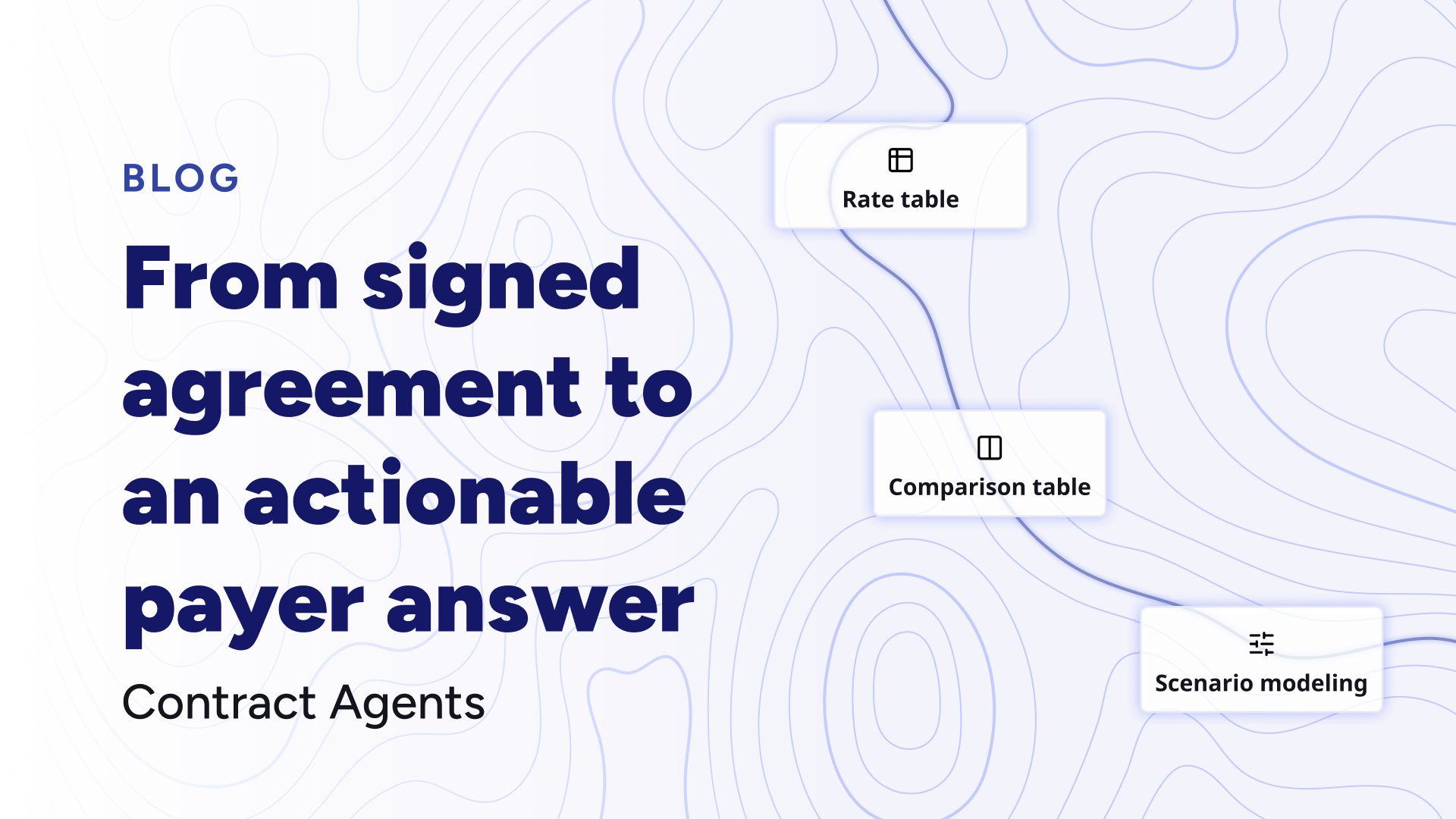
Trek Health’s Contract Agents support contract summaries, rate extraction, agreement comparisons, and financial scenario modeling (Trek Health’s Contract Agents). The standard I would hold those capabilities to is whether they help the reviewer understand what changed, what it means, and what to do next.
The renewal decision is still yours. The software should help you spend less of that decision process reconstructing the agreement and more of it evaluating the position you want to take.
Choose one payer question, whether it concerns a renewal offer, a billing requirement, or administrative obligations across agreements. Request a working session with Trek Health to explore how Contract Agents can help turn the underlying PDFs into a structured, source-backed answer.