Introduction
While medical specialties are becoming increasingly granular through advanced fellowships and subspecialty training, many share a common foundation: the standard outpatient office visit. For established patients, these encounters are billed under CPT codes 99213, 99214, and 99215, which represent varying levels of visit complexity and time. Because these codes span nearly every specialty, they create a rare opportunity for comparison in an industry where financial benchmarking is often fragmented or incomparable.
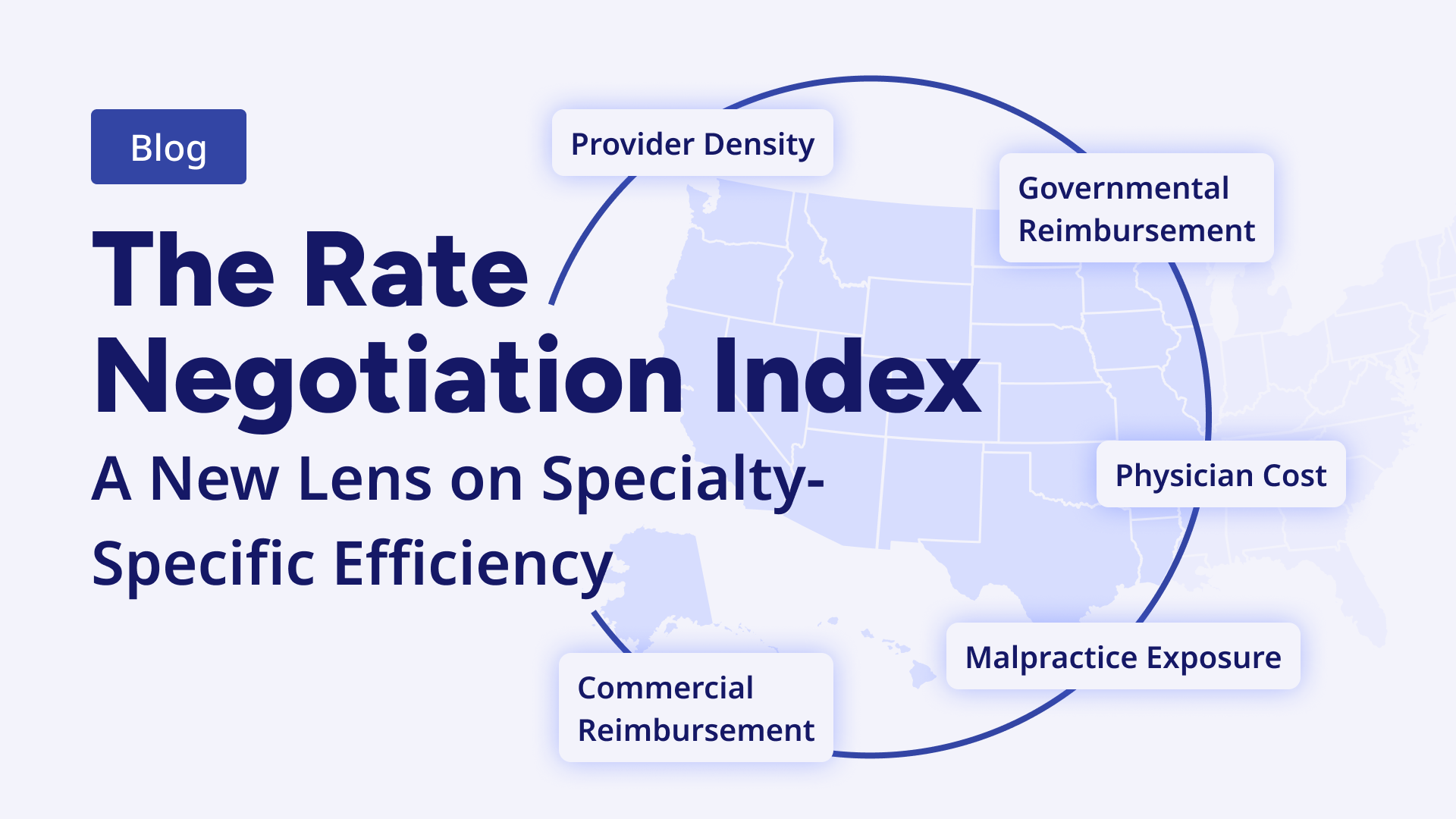
Using these common codes as a foundation, Trek Health developed the Rate Negotiation Index, a multivariate model that integrates commercial and governmental reimbursement rates, physician salary costs, malpractice exposure, and provider density. The result is a unified framework that evaluates each specialty–state combination by its relative financial efficiency and investment potential, helping healthcare operators identify where growth and consolidation may yield the greatest returns. These recommendations stem from a novel aggregation of the specialty- and state-specific reimbursement-to-salary ratio weighted for both Medicare and commercial rates and weighted to the state specific payer mix. This composite measure forms the Base Rate Negotiation Index score. The Advanced Rate Negotiation Index score builds upon it by allocating 80% weight to the base score, with 20% divided evenly to the malpractice multiplier and physician density multiplier. Together, these aspects capture both financial efficiency and operational risk.
Key Findings
While many mergers and acquisitions formulas include reimbursement and salary as factors in their assessments, Trek Health is able to integrate newly publicized commercial reimbursement data via the Transparency in Coverage ruling. Additionally, no publicly available model incorporates both malpractice and market saturation as variables. This comprehensive approach provides a multidimensional view of financial efficiency, accounting not only for revenue and cost but also for risk, scarcity, and strategic scalability.
These findings highlight pediatrics as one of the most undervalued yet opportunity-rich markets in U.S. healthcare. With relatively low physician salaries juxtaposed with relatively high commercial and governmental reimbursement rates, this specialty comes out on top for its investment potential. Compounding this, the specialty faces low malpractice exposure and widespread workforce shortages, creating a unique alignment of favorable economics and high demand. Together, these factors position pediatrics as a high-leverage investment opportunity in the evolving healthcare landscape.
Excluding pediatrics, the top specialty-state combinations include Endocrinology and Internal Medicine in Minnesota, as well as Family Medicine in Wisconsin. Further, Alaska, Minnesota, New Hampshire, North Dakota, and Wisconsin emerged as the most consistently high-ranking states across specialties by the Rate Negotiation Index, representing the nation’s most structurally advantageous markets for healthcare investment and physician network expansion.
Looking Ahead
The Rate Negotiation Index represents Trek Health’s ongoing commitment to using transparency-based data to translate market complexity into actionable strategy. As healthcare consolidation accelerates, understanding where efficiency converges with opportunity will be critical to sustainable growth. The full recommendations, rankings, and data will be available in our upcoming report, The Private Practice Playbook: Rate Negotiation Index Rankings for Specialty-Specific M&A Strategy, releasing on November 12th. Beyond just data reporting, Trek Health is building actionizable analytics driven by evidence-backed data.
For more insights or to explore how the Rate Negotiation Index can guide your organization’s strategic planning, contact Trek Health.