The Economics of Expertise: How Surgical and Fellowship Pathways Impact Reimbursement
Introduction
Medical specialties can be broken down by overlapping characteristics such as clinical focus, procedural intensity, patient acuity, and required training pathways, among others. Despite covering different scopes and patient profiles, there are great similarities in how these fields are structured in terms of workload, compensation models, and reimbursement patterns. Certain specialty classes are known anecdotally to command higher salaries, and assumedly, higher reimbursements: many of these include surgical subspecialties and those that require further training through fellowships.
Methodology
Using Trek Health’s Transparency Platform, we assessed commercial reimbursement across major payers (Aetna, BCBS, Cigna, UnitedHealthcare) across top medical and surgical specialties across CPT billing codes 99213, 99214, and 99215, evaluation and management visits for existing patients. After gathering the pertinent data, we developed an algorithm with capabilities to predict any one specialty’s reimbursement based on their individual makeup of a multitude of factors.
Surgery vs. Fellowship
The surgical specialties included Anesthesia, General Surgery, Neurological Surgery, Ophthalmology, Orthopedic Surgery, Otolaryngology, and Urology. The fellowship required specialties included Allergy/Immunology, Cardiology, Endocrinology, Gastroenterology, and Oncology/Hematology. Although many other specialties may have fellowships to further subspecialize, these are not mandatory to enter independent practice. In this blog, we explore the binary metrics of surgery and fellowships individually to evaluate their respective impact on commercial reimbursement. By focusing on these two categories, we start to see the nuances between surgical and fellowship-trained specialties: both highly complex in their own right, but differing in the ways they generate value and, ultimately, reimbursement. Surgical specialties, driven by operative demands and procedural risk, and fellowship-required specialties, defined by cognitive depth and longitudinal patient management, illustrate two different but equally complex paths within modern medicine.
CPT 99213 (Low Complexity Established Patient Visit)
- Surgical specialties received, on average, $12 higher reimbursement per visit than nonsurgical specialties, after adjusting for other variables.
- Fellowship-trained subspecialties were reimbursed approximately $47 more per visit, indicating that specialized expertise, beyond surgical designation, contributes significantly to pricing variation.
CPT 99214 (Moderate Complexity Established Patient Visit)
- Surgical specialties earned about $18 more per visit than nonsurgical ones, controlling for other factors.
- Fellowship-trained internal medicine subspecialties were reimbursed roughly $68 more per visit, underscoring that advanced specialization, not solely surgical status, drives higher reimbursement levels.
CPT 99215 (High Complexity Established Patient Visit)
- Surgical specialties were reimbursed approximately $26 more per visit compared to nonsurgical specialties.
- Fellowship-trained internal medicine subspecialties received an additional $97 per visit, highlighting the substantial premium associated with subspecialization at the highest complexity level.
Overall Impact
Notably, coefficients for surgical status and fellowship training, although mutually exclusive in the dataset, show a positive correlation, indicating that both categories exhibit parallel increases in reimbursement with higher visit complexity levels. The overall pattern indicates stable model behavior across CPT levels, with consistent directional effects for major predictors of reimbursement.
However, this analysis likely skews towards non-procedural specialties due to the inclusion of E/M billing codes, which make up a large portion of all specialties; however, the bulk of income generated from surgical specialties is through procedures. This analysis allows for:
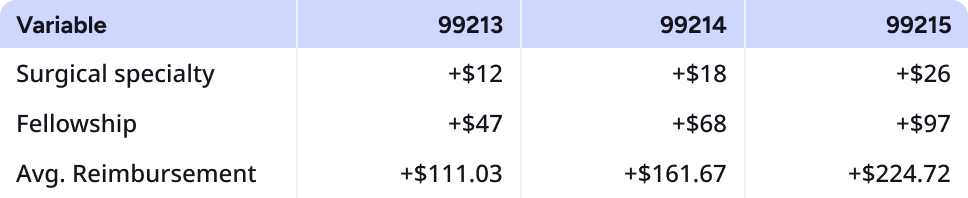
Fellowships provide not only a higher starting point influence, but also higher dollar increases with incremental codes. Surgical status produced a smaller but steady increment, reflecting an underlying structural bias toward procedural specialties that persists even in E/M codes. However, surgical influence has steeper percent increases across billing codes. The role of fellowships increase 42-45% by billing code, whereas surgical increments are 44-50%.
Effect on Physician Recruitment and Payer Negotiations
These reimbursement patterns carry direct implications for organizational strategy. From a payer negotiation perspective, quantifying the financial impact of specialized expertise strengthens an organization’s leverage in rate discussions. This increased leverage may serve as an incentive to recruit physicians who have subspecialized via a fellowship accreditation. These data-driven insights exemplify how expertise translates into reimbursement to become a competitive advantage.
Conclusion
Both surgical specialization and fellowship training serve as significant predictors of commercial reimbursement, though through different mechanisms: procedural complexity versus cognitive subspecialization. These findings reinforce the notion that healthcare reimbursement models reward both technical expertise and specialized knowledge, but in distinct ways that reflect the evolving economics of modern medical practice.
White Paper
From Transparency to Prediction: Quantifying the Drivers of Physician Reimbursement Variation
This analysis uses Transparency in Coverage data to model how payers behave, not just what they pay. By linking reimbursement rates to physician characteristics, we uncover the patterns behind payment variation and transform transparency data into predictive intelligence. The result: a predictive view of rate dynamics that helps stakeholders anticipate trends and negotiate with data-driven confidence.

White Paper
Q3 2025 State of Commercial Reimbursement: Trek Health’s Quarterly Market Intelligence
Trek Health’s Quarterly Reimbursement Brief highlights emerging variability in commercial payment rates across U.S. payers, specialties, and geographic markets. With some segments experiencing double-digit growth and others notable declines, contracting performance is increasingly shaped by real-time payer behavior rather than historical norms. Through validated reimbursement trend analytics, contract intelligence, and policy monitoring, Trek equips provider organizations to anticipate market shifts, protect revenue, and negotiate with measurable leverage.

White Paper
Reimbursement and Reality: The Economics of Breast Cancer Treatment
While breast cancer awareness efforts often focus on screening and treatment, one critical factor remains overlooked: how care is reimbursed. Payment structures shape far more than provider margins; they influence access, equity, and patient outcomes.
In this analysis of payer rates, Trek Health uses its Transparency Platform to analyze how reimbursement for breast cancer care varies across geography, commercial payer behavior, and public policy. The findings reveal a system that rewards disease burden rather than prevention which creates inequities that ripple through the entire care process.
Inside you’ll learn:
- How reimbursement rates differ dramatically by state and payer
- Why higher disease burden correlates with higher payment, but prevention does not
- What these trends mean for provider strategy, patient access, and equity
Download the full analysis to see how transparency data can help reshape breast cancer care—turning financial insight into fairer outcomes.

White Paper
The Private Practice Playbook: Rate Negotiation Index Rankings for Specialty-Specific M&A Strategy
Physician economics are shifting as private equity and independent platforms redefine the workforce landscape. Trek Health’s Rate Negotiation Index Report quantifies the return on physician labor across states and specialties in a new lens: combining commercial reimbursement, physician salary, malpractice risk, and provider density into a single metric. This data driven foundation for smarter M&A strategy identifies the most economically sustainable opportunities across the U.S. for physician recruitment and network expansion.

Introduction
Medical specialties can be broken down by overlapping characteristics such as clinical focus, procedural intensity, patient acuity, and required training pathways, among others. Despite covering different scopes and patient profiles, there are great similarities in how these fields are structured in terms of workload, compensation models, and reimbursement patterns. Certain specialty classes are known anecdotally to command higher salaries, and assumedly, higher reimbursements: many of these include surgical subspecialties and those that require further training through fellowships.
Methodology
Using Trek Health’s Transparency Platform, we assessed commercial reimbursement across major payers (Aetna, BCBS, Cigna, UnitedHealthcare) across top medical and surgical specialties across CPT billing codes 99213, 99214, and 99215, evaluation and management visits for existing patients. After gathering the pertinent data, we developed an algorithm with capabilities to predict any one specialty’s reimbursement based on their individual makeup of a multitude of factors.
Surgery vs. Fellowship
The surgical specialties included Anesthesia, General Surgery, Neurological Surgery, Ophthalmology, Orthopedic Surgery, Otolaryngology, and Urology. The fellowship required specialties included Allergy/Immunology, Cardiology, Endocrinology, Gastroenterology, and Oncology/Hematology. Although many other specialties may have fellowships to further subspecialize, these are not mandatory to enter independent practice. In this blog, we explore the binary metrics of surgery and fellowships individually to evaluate their respective impact on commercial reimbursement. By focusing on these two categories, we start to see the nuances between surgical and fellowship-trained specialties: both highly complex in their own right, but differing in the ways they generate value and, ultimately, reimbursement. Surgical specialties, driven by operative demands and procedural risk, and fellowship-required specialties, defined by cognitive depth and longitudinal patient management, illustrate two different but equally complex paths within modern medicine.
CPT 99213 (Low Complexity Established Patient Visit)
- Surgical specialties received, on average, $12 higher reimbursement per visit than nonsurgical specialties, after adjusting for other variables.
- Fellowship-trained subspecialties were reimbursed approximately $47 more per visit, indicating that specialized expertise, beyond surgical designation, contributes significantly to pricing variation.
CPT 99214 (Moderate Complexity Established Patient Visit)
- Surgical specialties earned about $18 more per visit than nonsurgical ones, controlling for other factors.
- Fellowship-trained internal medicine subspecialties were reimbursed roughly $68 more per visit, underscoring that advanced specialization, not solely surgical status, drives higher reimbursement levels.
CPT 99215 (High Complexity Established Patient Visit)
- Surgical specialties were reimbursed approximately $26 more per visit compared to nonsurgical specialties.
- Fellowship-trained internal medicine subspecialties received an additional $97 per visit, highlighting the substantial premium associated with subspecialization at the highest complexity level.
Overall Impact
Notably, coefficients for surgical status and fellowship training, although mutually exclusive in the dataset, show a positive correlation, indicating that both categories exhibit parallel increases in reimbursement with higher visit complexity levels. The overall pattern indicates stable model behavior across CPT levels, with consistent directional effects for major predictors of reimbursement.
However, this analysis likely skews towards non-procedural specialties due to the inclusion of E/M billing codes, which make up a large portion of all specialties; however, the bulk of income generated from surgical specialties is through procedures. This analysis allows for:

Fellowships provide not only a higher starting point influence, but also higher dollar increases with incremental codes. Surgical status produced a smaller but steady increment, reflecting an underlying structural bias toward procedural specialties that persists even in E/M codes. However, surgical influence has steeper percent increases across billing codes. The role of fellowships increase 42-45% by billing code, whereas surgical increments are 44-50%.
Effect on Physician Recruitment and Payer Negotiations
These reimbursement patterns carry direct implications for organizational strategy. From a payer negotiation perspective, quantifying the financial impact of specialized expertise strengthens an organization’s leverage in rate discussions. This increased leverage may serve as an incentive to recruit physicians who have subspecialized via a fellowship accreditation. These data-driven insights exemplify how expertise translates into reimbursement to become a competitive advantage.
Conclusion
Both surgical specialization and fellowship training serve as significant predictors of commercial reimbursement, though through different mechanisms: procedural complexity versus cognitive subspecialization. These findings reinforce the notion that healthcare reimbursement models reward both technical expertise and specialized knowledge, but in distinct ways that reflect the evolving economics of modern medical practice.