The payer relationship has never lived in one place. Now it does.
Only 26% of provider organizations model the financial impact of a payer policy change before it hits reimbursement. Fourteen percent find out after the revenue is already gone.
Those numbers come from a survey of 161 healthcare finance leaders that Trek Health conducted with HFMA this year. They describe a structural problem, not a diligence problem. The information required to catch a policy change before it costs you money is scattered across four systems that were never designed to talk to each other:
No single person or team owns the whole picture. So the gap between what a contract promised and what actually landed on the remit goes unmeasured, until someone stumbles into it, usually a quarter or two too late.
Today we're launching the new Trek Health Platform to close that gap: one connected environment for the entire financial relationship between providers and payers, with four collections of AI agents built to act on it.
Where we started
We founded Trek five years ago on a narrow bet: that if providers could see what payers were actually paying everyone else, they would negotiate better contracts.
That bet worked. More than 150 provider organizations use Trek today, and on average they negotiate reimbursement 10.4% above market benchmarks, with individual customers achieving rate increases of 15% to 30%.
How we measure this: we compared negotiated rates drawn from price transparency data across the NPIs and tax IDs of more than 100 provider organizations actively using Trek's market intelligence platform in live payer negotiations, benchmarked against their market comparables, meaning organizations with the same provider taxonomies that don't use Trek. The sample is representative of our customer base and spans millions of providers in the healthcare workforce.
But better rates were never the endgame. A negotiated rate is a promise, not a payment. Whether it's realized depends on payer policy, coding, claims adjudication, and how the agreement gets operationalized across a dozen teams. A policy change can quietly reduce your reimbursement without touching a single contract term.
Every managed care leader we talk to describes some version of the same problem: I'm confident we're losing money between the contract and the remit. I can't prove where.
The new platform is our answer.
What's new
One platform for payer performance. Trek now connects the two sides of the payer relationship that have historically been impossible to connect: external market signals (negotiated rates, market benchmarks, payer policies) and your own data (contracts, fee schedules, claims, and remittances). Organizations connect the systems and files where that data already lives.
Expected vs. actual, in dollars. A contract tells you what should have happened. A claim tells you what did. The platform holds those side by side, with market data and payer policy in view at the same time, so the gap between expected and actual reimbursement stops being an intuition and becomes a number you can put in front of a payer.
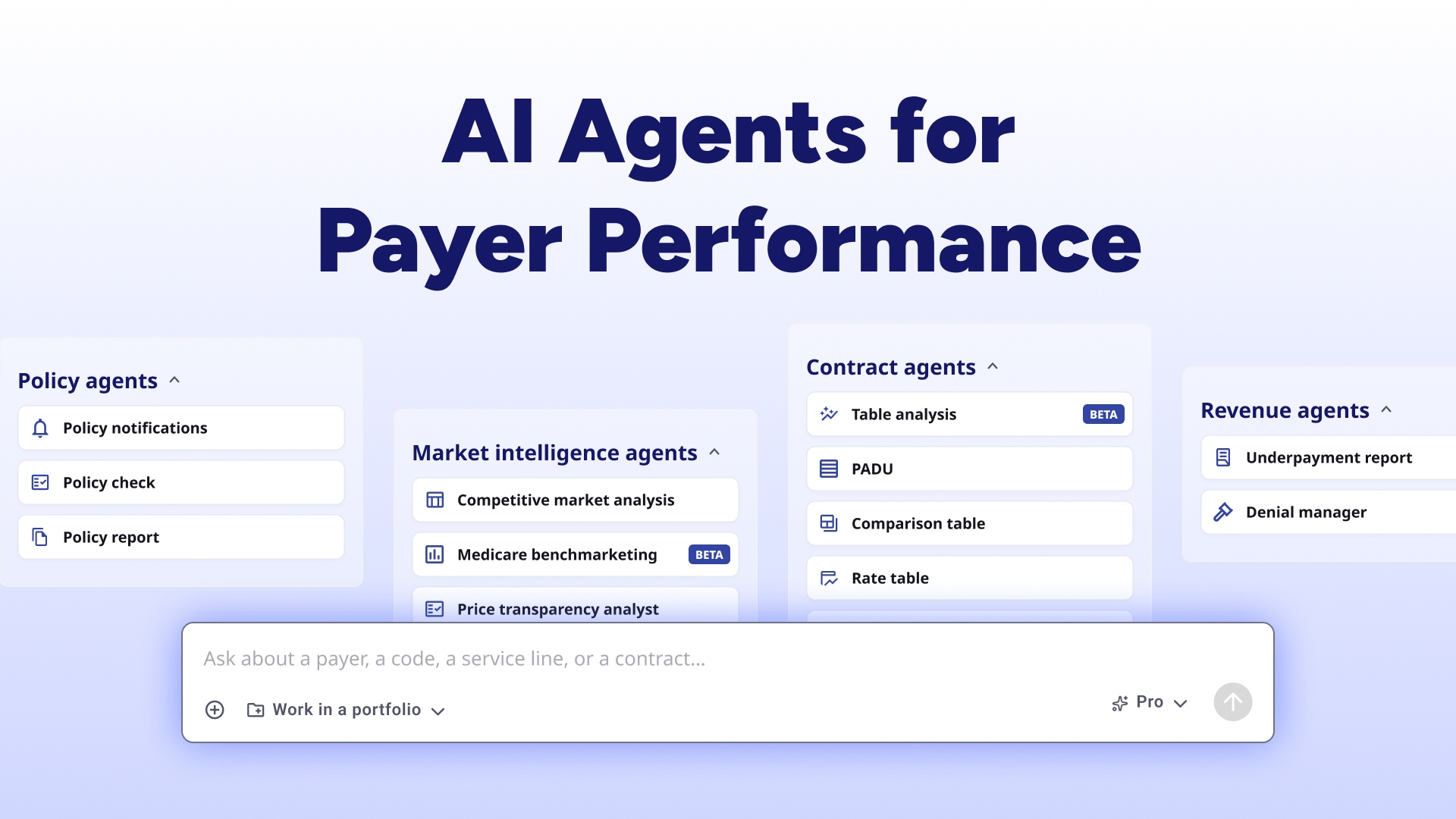
Four collections of AI agents. Connecting the data is only half the equation. Finance teams already have more information than they can review; what they lack is capacity to act on it. So the platform ships with purpose-built agents across the four workflows that determine payer performance:
Evidence behind every answer. Agents don't return conclusions alone. They return the underlying contract language, market data, and claims evidence. Every number is traceable to its source, which means it holds up in front of a payer, an auditor, or your own CFO.
Why it compounds
These workflows feed each other. Market data surfaces the opportunity and informs the negotiation. Contract terms establish what should happen. Policy updates warn you what's changing. Claims show whether the expected reimbursement was actually realized, and wherever it wasn't, the finding feeds straight back into the next negotiation.
Each turn of that loop makes the next one sharper. A denial pattern you can prove is a contract term you can rewrite. A rate you won is only a rate you keep if the claims confirm it.
That loop of expected vs. actual, running continuously, is what we mean by payer performance. And it's a loop payers have had to themselves for decades.
Your data stays yours
Every organization's data is isolated to that organization and used only for its own payer-performance workflows. We do not pool customer data, and we do not use one customer's claims or contracts to inform another's.
Availability
The new platform is rolling out in Beta to a first batch of 15+ provider enterprises beginning early September, ahead of broad rollout to all customers.
Already a Trek customer? Your account team will contact you to schedule the transition and move your workspaces over with you. Your existing data, benchmarks, and saved work come with you.
New to Trek? Book a demo and we'll run your actual contracts and rates through the platform, live, and show you the gap between what you're owed and what you're being paid.
For decades, payers have been the only party in the relationship who could see the whole picture. That asymmetry isn't a law of nature. It's a tooling problem, and it's the one we're solving.