Consider a payer asking an infusion program to obtain a medication from an outside specialty pharmacy instead of purchasing it for administration from the provider’s own inventory. A lower drug price might be part of the payer’s case, but it would not answer the provider’s most important questions: what work stays with us, what reimbursement changes, and can we deliver care safely under the proposed arrangement?
Those are the questions worth preparing for as drug price transparency expands. The goal should be a better-supported payer conversation, not another spreadsheet of prices that no one knows how to use.
What is coming, and what it will tell you
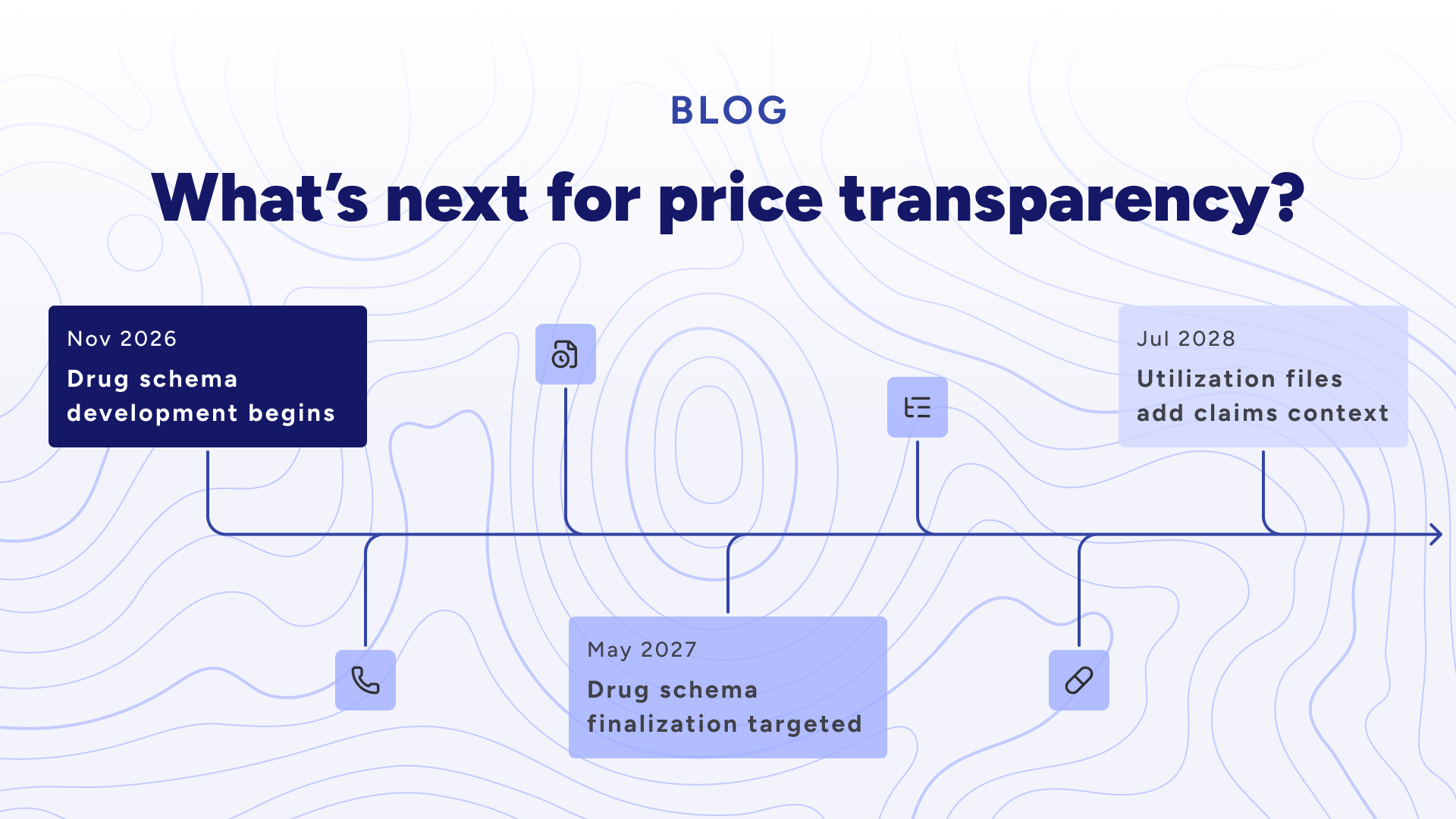
CMS’s October guidance sets out a roadmap for prescription-drug pricing files: schema development beginning in November 2026, an initial schema release on or around May 2027, and publication using that schema expected from December 2027, monthly thereafter (CMS FAQs Part 75). The original disclosure design includes negotiated rates and historical net prices for covered prescription drugs by plan or issuer at the pharmacy-location level (CMS’s original rule fact sheet).
That is a reason to plan for more information about the dispensing side of drug spending. It is not a reason to assume that every published price will be a usable benchmark for a hospital’s infusion reimbursement.
My recommendation is to start with an existing payer decision, then identify whether the new information could help resolve it. That keeps the work tied to an actual contract, service, and patient-care question.
Start with the arrangement, not the drug name
For a provider organization, the first distinction is how the medication reaches the patient and which entity is responsible for each part of the service. The American Hospital Association describes buy-and-bill as the provider purchasing and administering the drug, with reimbursement for the drug and administration; in white-bagging arrangements, an outside specialty pharmacy dispenses the medication and sends it to the provider for administration (AHA’s explanation of the models).
Use those distinctions to frame different questions for the payer. Do not treat them as interchangeable ways to earn the same drug reimbursement.
- Your organization purchases and administers the drug: Does the applicable medical-benefit contract support the expected drug and administration reimbursement? Which pricing terms, effective dates, or sourcing restrictions need attention?
- Your organization administers an externally supplied drug: What responsibilities remain with your team, and how will they be paid for? What happens when delivery, dosing, or treatment plans change?
- Your organization’s pharmacy dispenses the drug: Is the issue reimbursement, network participation, or access to the product? Establish that before treating another pharmacy’s rate as an attainable alternative.
The last question matters because operating a pharmacy does not by itself establish access to every payer network or limited-distribution drug; ASHP’s 2025 policy report describes payer-network contracting and manufacturer limited-distribution agreements as separate access constraints (ASHP’s pharmacy-access analysis). A higher observed rate elsewhere is not, on its own, a pharmacy expansion plan.
Put one real payer issue on one page
Do not launch a new organization-wide audit solely because a file is coming. Bring one consequential drug-related issue already on the agenda into the next existing payer-performance or contracting review.
For example, choose a proposed sourcing change affecting an infusion program, a reimbursement term approaching renewal, or a network restriction affecting your pharmacy. Ask managed care to assemble the contract position, pharmacy and clinical operations to validate the care requirements, and finance to model the relevant economics.
The output should be a short decision brief with five parts. Each part should point to the source evidence or clearly identify what is still unknown.
- Current arrangement: Identify the therapy, payer and affected plans, location, benefit pathway, who acquires or dispenses the drug, and who bills for each service.
- Proposed change: State exactly what the payer is asking to change, when it would apply, and which agreement, amendment, or policy is cited. Flag unresolved questions about contractual applicability for review.
- Financial effect: Compare the relevant drug and administration allowances, acquisition expense where your organization purchases the drug, and the costs of the work your team would still perform. Separate modeled reimbursement from cash collection.
- Care and operational effect: Document the actual handling, scheduling, coordination, or treatment-continuity issues relevant to this arrangement. Have clinical and pharmacy leadership validate which options are acceptable.
- Specific payer request: Name the change you want, such as revised administration compensation, a defined exception process, clarification of a contract provision, or consideration for network participation where appropriate.
ASHP’s white-bagging self-assessment specifically calls for reviewing contract terms, treatment delays, storage and handling responsibilities, and labor or overhead not accounted for in historical administration fees (ASHP’s hospital and health-system self-assessment). Use those considerations to make the payer request specific to the work and care requirements at your site.
Show the change in economics, not just lost revenue
Consider a simplified, illustrative infusion episode under two arrangements. The figures below are assumptions, not observed prices or a reimbursement benchmark.
In this example, the provider’s modeled drug allowance falls by $1,000, but its acquisition expense also falls by $900. The remaining $150 deterioration comes from the loss of the $100 difference between drug allowance and acquisition expense, plus $50 in assumed additional delivery costs.
That is a more useful starting point for negotiation than saying, “We lose $1,000 per treatment.” The next question is whether the proposed administration payment, responsibilities, and exception process support the care the provider is expected to deliver.
The calculation is deliberately limited: it uses allowances rather than collected cash and excludes costs or concessions not listed. It is not profit, a full payer-cost comparison, or a claim that the provider is entitled to preserve a particular contribution.
Use your organization’s actual terms and costs to make the case. A lower drug price at an outside pharmacy would not, by itself, resolve whether the provider’s remaining services are adequately addressed.
Decide where public prices would strengthen the case
Once relevant disclosures are available, ask whether they add a defensible comparison to the decision brief. Require a documented match on the drug, unit basis, payer and network context, pharmacy location or relevant setting, reporting period, and type of price before using a comparison in a payer discussion.
Keep negotiated rates separate from historical net prices. The latter is defined as a retrospective average paid by the plan or issuer, incorporating allocated rebates and other concessions; it is not a measure of the provider’s acquisition expense or contribution (federal pricing definitions).
A well-matched disclosed rate could support a question about dispensing reimbursement or a proposed alternative. It cannot establish your contract entitlement, settle a clinical sourcing question, or substitute for the cost of work performed at your site.
If the data does not fit the decision, leave it out of the financial model. A stronger payer discussion does not require forcing a public benchmark into every argument.
Prepare for a better payer conversation
The practical next step is to choose one material drug-related payer issue and complete the decision brief before the next relevant negotiation or review. Leave that discussion with a defined request and an owner, or a clear decision that the available evidence does not justify action.
Drug price transparency will be useful to providers when it helps answer a specific question about reimbursement, access, or the responsibilities of delivering care. The work starts by knowing which question you are trying to answer.
If you are working through a drug-related payer decision, talk with Trek Health about the contract, policy, and market evidence behind it. Start with the decision that matters to your organization, then determine what additional data would make it better.