By Dilpreet Sahota, CEO, Trek Health · September 16, 2026 · 5 min read
CMS's proposed CY2027 conversion factor cut looks like a Medicare story. Because most commercial contracts are still written as a percentage of Medicare, it isn't. Here's the math.
What CMS actually proposed
On July 14, 2026, CMS released the CY2027 Medicare Physician Fee Schedule proposed rule. Two numbers matter for anyone modeling revenue:
- The non-qualifying APM conversion factor drops from $33.40 to $32.84, a -1.68% cut. The qualifying APM factor drops from $33.57 to $33.17, a -1.19% cut.
- CMS separately proposed to reduce payment for a separately identifiable office/outpatient E/M visit furnished on the same day as a 0-, 10-, or 90-day global procedure. The most expensive service is paid at 100% and additional services on the same day are reduced.
Comment period closed September 14, 2026. The final rule is expected around November 1, effective January 1.
Why this is a commercial rate story, not a Medicare story
Most commercial contracts are still written as a percentage of Medicare, so the Medicare Physician Fee Schedule quietly sets the ceiling for private pay. When the conversion factor moves, the base rate moves for every code on every commercial contract indexed to it, automatically, unless a contract has a floor, a base-year lock, or an explicit renegotiation clause.
Milliman puts 2025 commercial reimbursement at roughly 196% of fully loaded Medicare on average across medical services. That's the ratio that gets applied on top of the conversion factor. Cut the factor 1.68% and the whole stack scales down with it.
Simple version: if a commercial payer pays you "150% of Medicare" for a code, and Medicare's base rate for that code falls 1.68% on January 1, your commercial rate for that code falls 1.68% too. Nobody at that payer will call you to negotiate it.
What this looks like on a real book
Take a mid-sized multispecialty group booking $180M in commercial physician revenue. Assume 68% of that revenue runs through contracts indexed to Medicare, and roughly 12% of revenue comes from same-day E/M billed alongside procedures. Apply the CY2027 proposal at non-APM rates and the E/M reduction on top:
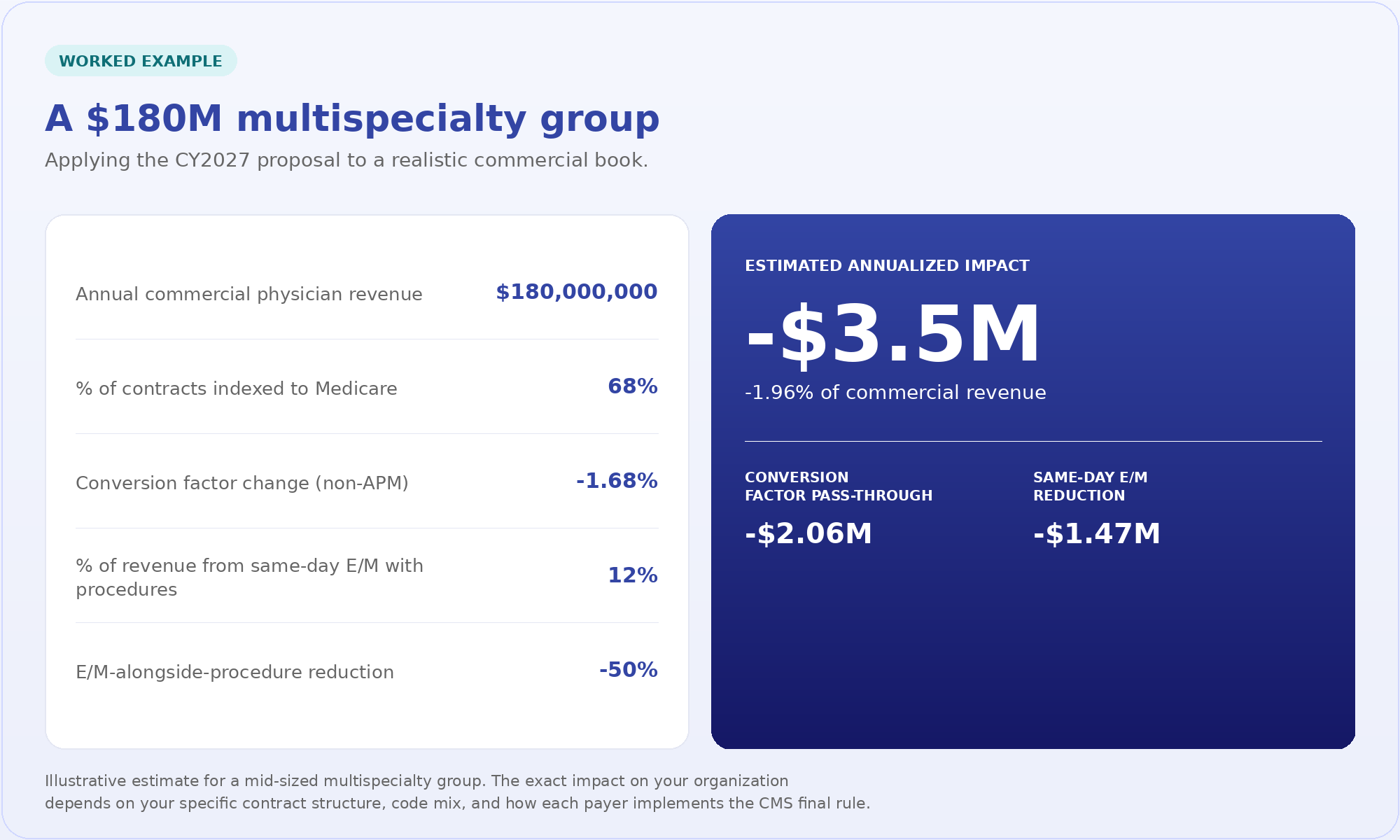
Two numbers stand out. First, the conversion factor pass-through is the larger of the two effects, worth about -$2.1M a year on this book. It hits every commercial contract indexed to Medicare, on every code, without a renegotiation. Second, the same-day E/M reduction adds another -$1.5M, concentrated on procedural service lines. On a $500M book, roughly double both numbers.
Why most providers will miss it
Three structural reasons:
- Contract review is annual and reactive. Most managed care teams review contracts on their anniversary date, not on a policy calendar. A January 1 pass-through hits before the review cycle catches it.
- Nobody knows their starting rates. Without a normalized rate baseline across payers and codes, you can't detect a 1.68% shift; it looks like noise in the AR aging.
- MRF data has become usable, but not automatically. Hospital and payer machine-readable files now contain enough signal to benchmark rates, but only after normalization, deduplication, and joining to your own contract terms.
Three questions every RCM director should answer by November 1
- Which of my commercial contracts are Medicare-indexed? List every payer × product × service-line rate table, and flag which reference the CMS PFS, OPPS, or ASC schedules, and which have base-year locks that insulate you.
- Where do I sit vs. peers on my top 20 codes? Your renegotiation ceiling is set by what your payer already pays comparable providers in your market. If you can't cite it, you can't defend a rate ask.
- Which contracts open for renegotiation before January? Rank contracts by renegotiation window × Medicare-index exposure × revenue concentration. That's your priority list, not the last person who called.
What we're recommending our customers do
Between now and October 31: build a one-page position statement for each of your top five payers, containing (a) current effective rates on the top 20 codes by revenue, (b) peer benchmarks from the latest MRF snapshot, (c) the 2027 pass-through delta at proposed rule levels, and (d) the specific redlines you want in your next renewal.
Providers who walk into a fall renegotiation with that document reset the starting point. Providers who don't will find out in Q1 close what the industry-wide silent cut cost them.
Free through October: Trek will pull your effective rates from the latest MRFs, benchmark them against peers, layer the CY2027 proposal on top, and hand back a one-page position statement per payer. Turnaround: 5 business days. Request your rate check.
Sources
- CMS, Calendar Year (CY) 2027 Medicare Physician Fee Schedule Proposed Rule Fact Sheet, July 14, 2026.
- Milliman, Commercial reimbursement benchmarking, 2025.
- AAFP, Summary of the CY2027 Medicare Physician Fee Schedule Proposed Rule, 2026.
- NAHRI, 2027 MPFS proposed rule: Sweeping changes in store for E/M and global periods, 2026.
- Fulcrum Health Partners, The State of Commercial Payer Contracting in 2026.