Suppose a payer allows $115 for a July office visit. Your rate file says $125. The analyst who spots the $10 difference finds 300 visits with the same flag. Now finance has a reasonable question: “Does this payer owe us $3,000?”
Before I’d put that number in front of a CFO, I’d want to see one thing: the line in the contract that makes $125 the right rate for the first claim. If we can’t establish that, finding 299 more flags hasn’t made the case stronger. It may just mean we’ve used the wrong rate 300 times.
Where did the $125 come from?
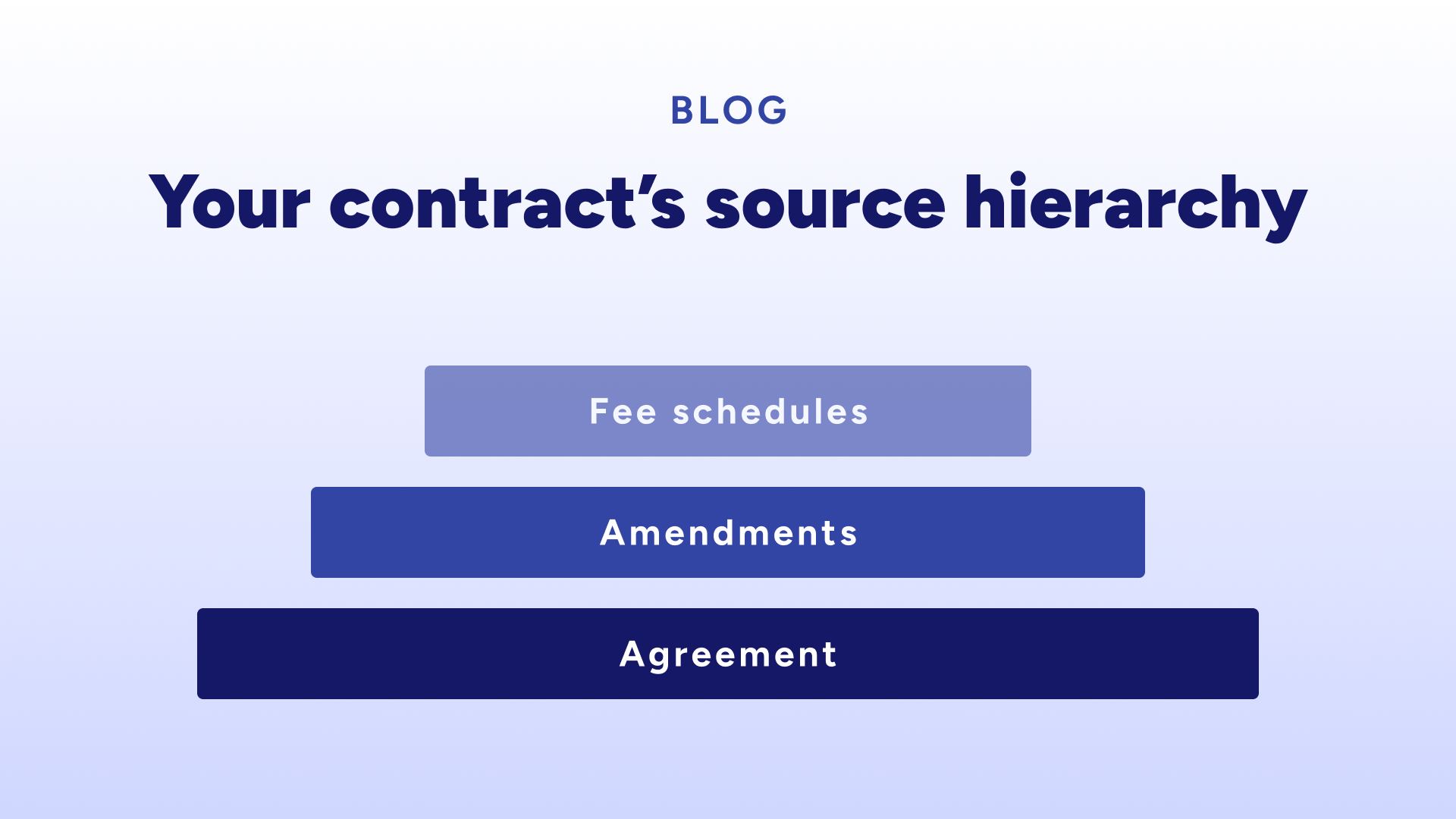
In this example, the signed agreement covers two products. It points to Exhibit A for PPO services and Exhibit B for HMO services. A signed amendment replaces Exhibit A for dates of service beginning July 1. The attached fee schedule lists the office visit at $125.
The analyst who loaded the schedule got the payer, code, date, and dollar amount right. What didn’t make it into the rate file were three words from the amendment: “for PPO services.” The first claim that landed in the work queue was an HMO visit.
That’s why the agreement, amendment, and fee schedule are worth reading together. The schedule gives you the amount. The amendment tells you what changed and when. The agreement tells you which exhibit to follow for this patient’s plan. That’s the source hierarchy in this example, not a rule that one document type always wins. If two signed documents appear to govern the same service and disagree, give the contract owner both passages rather than picking the PDF with the later date.
One bad match doesn’t invalidate all 300 flags
For the HMO visit, we now know that the PPO schedule doesn’t support a $10 dispute. We still don’t know whether $115 was correct. And we haven’t learned anything yet about whether the payer allowed the right amount on the PPO visits.
I’d ask the analyst to pull the claims that used that rate-file entry, not every claim from the payer. Separate PPO, HMO, and unknown product. Within each group, compare like claim lines: same service code, applicable modifier, setting, units, and service dates covered by the schedule. Use the allowed amount from the remittance, not the payer’s check alone; a patient’s share is not a payer shortfall.
Here’s how the $3,000 headline could change. Suppose 180 of the 300 visits are PPO, 90 are HMO, and 30 have no reliable product match. If all 180 PPO lines meet the contract terms for $125 and were allowed at $115, $1,800 is supported for dispute. The other $1,200 is neither confirmed underpayment nor money to write off. It’s the portion of the original flag the team hasn’t substantiated.
Give each group a different next action
- PPO: take the supported pattern to the payer. Send the signed amendment, the referenced schedule row, representative remittances, and the affected claim list. Ask the payer to review how it priced those visits and reprocess the affected lines. Track the $1,800 as disputed, not recovered.
- HMO: get the governing exhibit and fix the rate mapping. Contracting owns the request for Exhibit B and any amendment in effect on the service dates. If those documents support $115, correct the internal rate file and rerun the HMO claims. If they support a higher amount, calculate the HMO variance on its own terms. Either way, stop using the PPO rate as the default.
- Unknown product: resolve the missing information. Give the 30 unmatched visits to the team that can verify plan enrollment for the dates of service. Keep them visible on the worklist, but out of the dispute total until someone can show which terms apply.
The update I’d send finance is short: “We reviewed 300 flagged visits. We can support a $1,800 PPO dispute. Contracting is validating the HMO exhibit for 90 visits, and 30 still need a product match. No recovery is booked.”
That gives finance a number it can defend, the payer a specific issue it can investigate, and the team a clear owner for every open claim. The useful question at the next review isn’t “How many dollars did we flag?” It’s “Which dollars can we support, and what do we need to resolve the rest?”